
6061 vs 6063 Aluminum: Which Alloy for Your Extruded Part

The short answer6061-T6 is about 30 percent stronger and welds and machines better, so it is the alloy for frames, bases and rails that carry a load. 6063 extrudes faster and thinner, anodizes brighter and lands 10 to 20 percent cheaper per kilogram, so it is the alloy for trim, heatsinks, housings and anything a customer looks at. Pick by what the part does, not by the bigger strength number.
The two alloys that land on my desk more than any other
Almost every aluminum extrusion RFQ I see says 6061 or 6063 on the drawing, and about a third of them say the wrong one. Not wrong in a way that fails the part. Wrong in a way that costs 10 to 20 percent on every kilogram, adds a week to the die trial, or turns a bright anodized rail into a streaky one, when the other alloy would have done the job cleanly. The two alloys are cousins. Both are aluminum with magnesium and silicon, both extrude, both anodize, both take a T5 or T6 temper. The difference is how much magnesium and silicon, and that small difference decides whether the alloy is easy to push through a die and bright after anodizing, or strong under load and good to weld. This note walks through the five questions I ask before the alloy goes on the drawing, in the order I ask them.
Question 1: Does the part carry a load, or does it carry a look
This is the whole decision most of the time. 6061-T6 gives about 310 MPa tensile and 276 MPa yield. 6063-T6 gives about 241 MPa tensile and 214 MPa yield, and 6063-T5, the more common temper, sits at about 186 MPa. So 6061 is roughly 30 percent stronger at the same section. If the extrusion is a machine base, a frame that carries a motor, a rail that holds a load in bending, a truck bed rail or a ladder side, the strength buys you a thinner wall or a bigger safety margin, and 6061 earns its price. If the extrusion is a window frame, a trim strip, a heatsink, an LED housing, a shower door track or a display rail, the load is small and the surface is what the customer sees, and 6063 is the alloy that was made for it.
The trap is picking 6061 because it is the stronger number and strength feels safe. Strength you do not use is money you pay on every kilogram, and it comes with two other bills that show up later, at the press and in the anodize tank.
Question 2: How thin is the wall, and how complex is the section
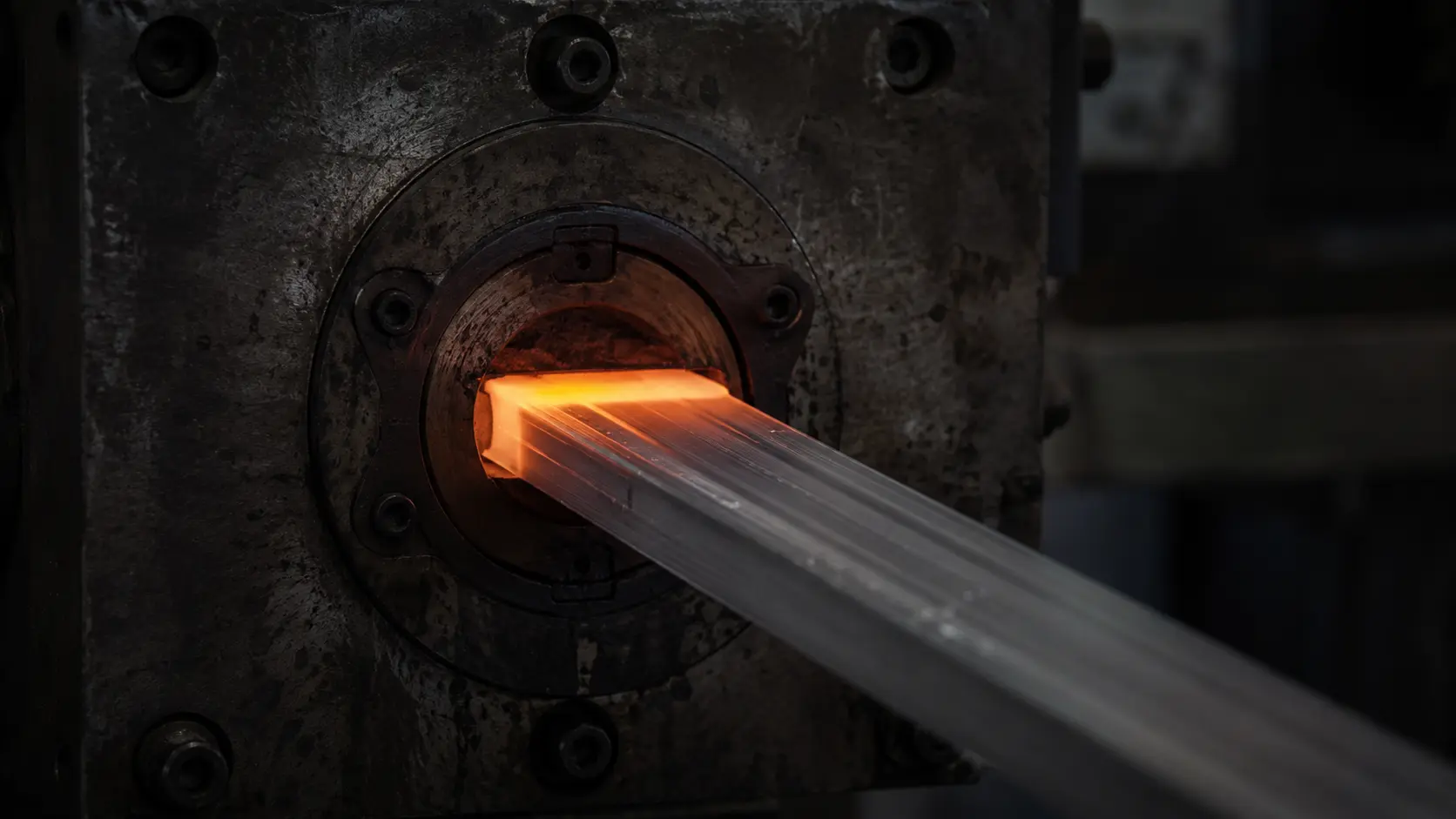
6063 extrudes easily. The billet flows at a higher press speed, the die sees less wear, and our partner presses run 6063 walls down to about 1 mm on small solid sections, rising as the section gets bigger. Complex hollow shapes with several voids, thin fins on a heatsink, and long narrow tongues on a slot all run clean in 6063. 6061 is harder to push. Press speeds drop, the die works harder and needs polish and nitride attention sooner, and the practical minimum wall on the same small section climbs to about 1.5 mm, more on a hollow. A heatsink with 1.2 mm fins at 8 mm pitch drawn in 6061 will come back from DFM with a question, because the fins will not fill at a speed the press can hold, and the answer is either 6063 or thicker fins.
If the section is simple and the walls are 2 mm or more, both alloys run and the question does not decide anything. If the section is thin, hollow or intricate, it decides everything, and it decides for 6063.
Question 3: Is the surface anodized, and does the customer look at it
Anodizing is where 6061 disappoints buyers who did not expect it. 6063 anodizes bright and even, in clear, black or color, and holds a color range board lot after lot, which is why most architectural profiles are 6063 or its close cousin 6060. 6061 anodizes a touch greyer and less bright, and on T6 material it can show streaks along the extrusion direction from the way its alloying elements settle, so two lengths from the same lot can look different next to each other. That is fine on a machine base under a guard. It is not fine on a rail a customer runs a hand along. If the part is anodized and visible, 6063 wins. If it is powder coated, the coat hides the difference and the question falls away.
| What you are deciding | 6063the surface alloy | 6061the structural alloy |
|---|---|---|
| Strength, T6 | About 241 MPa tensile, 214 yield | About 310 MPa tensile, 276 yield |
| Extrudability | Fast press speed, walls to 1 mm, complex hollows | Slower press, walls to about 1.5 mm, more die wear |
| Anodized finish | Bright, even, holds a color range | Grey, can streak, best under powder coat |
| Welding and machining | Fine, but soft, marks between operations | Welds and machines well, the shop expects it |
| Price per kg, landed | Base | About 10 to 20 percent more |
| Die life | Longer between corrections | Correction and polish sooner |
| Usual temper | T5, T6 with a proper quench | T6 |
| Typical parts | Frames, trim, heatsinks, LED housings, rails | Machine bases, structural frames, truck rails, ladders |
marks the alloy that wins the row.
Question 4: Will the part be welded or heavily machined
6061 welds well and machines well, and it is the alloy the whole US fabrication world knows. Frames that get TIG welded into structures, sections that get long slots and tapped holes milled into them, and parts that bolt into steel assemblies are usually better in 6061, because the shop downstream expects it and the joint strength holds. 6063 welds too, and it machines cleanly, but it is softer, so a heavily machined 6063 part can pick up handling marks on the show faces between operations. On a heatsink that gets a few drilled holes, that does not matter. On a frame with 40 machined features, it does.
Here is a mistake we caught on one of our programs. A heatsink for a power supply came across as 6061-T6, because the engineer had used 6061 on every machined part in the product and kept the material. The fins were 1.3 mm at 7 mm pitch, anodized black, 60,000 pieces a year. The first die trial did not fill the fin tips. The partner slowed the press, filled them on the second trial, and the price per kilogram came in about 18 percent above what the same section runs in 6063, with the black anodize showing faint lines the customer questioned on the first lot. We moved it to 6063-T5 at the next die, the fins filled at full speed, the anodize came out clean, and the part lost nothing it needed, because a heatsink carries heat, not load. The lesson was not about alloys. It was that the alloy on a drawing is often inherited from the part next to it, and nobody asked whether this part needed it.
The strong alloy is not the safe choice when strength is not what the part is for.
Question 5: What does each one cost, all the way to your dock
On the programs we run, 6061 billet costs about 5 to 10 percent more than 6063, and the slower press speed and shorter die life add another 5 to 10 percent, so a 6061 profile lands about 10 to 20 percent above the same section in 6063 per kilogram. Die cost is similar, $400 to $3,000 for a solid or hollow die, but a 6061 die wants a correction and polish cycle sooner, so over a 3 year program the tooling line runs a little higher too. Lead time is the same on paper, 4 to 7 weeks to first article, and 1 week longer in practice on 6061 if the section is thin, because the first trial is more likely to need a second. None of this is a reason to avoid 6061 when the part needs the strength. It is a reason to be sure it does.
6063-T5, fin 1.2 mm at 8 mm pitch
6061-T6, fin 1.5 mm at 10 mm pitch
press at full speed, fins fill on trial 1
press slowed to fill the fins
9 fins on a 72 mm base, anodized black, clean
7 fins on the same base, anodized black, faint lines
about $5.20 per kg landed
about $6.10 per kg landed
orange = the fin the alloy decides. Not to scale. Prices are indicative for this section and volume.
T5 or T6, and why the oven matters more than the letter
The temper is the heat treatment after the press. T5 means the profile was cooled at the press and then aged in an oven. T6 means it was solution treated and quenched properly, then aged, and it is the stronger of the two. 6063 is usually sold as T5 and reaches T6 with a proper quench. 6061 is usually T6 because it is bought for strength. The number that matters to you is not the letter on the cert but the hardness reading on the lot. A Webster gauge reading on every aged lot, and a tensile pull to ASTM B557 on the first article, is how you know the oven cycle was real. We have seen T6 on the paperwork and T5 on the gauge, and the profiles bowed at install because they were softer than the drawing assumed. Ask for the reading, not the letter.
What to write on the drawing
- The alloy and temper together, 6063-T5, 6063-T6 or 6061-T6, never the alloy alone.
- The minimum wall and the circumscribing circle, so DFM can check extrudability before the die is cut.
- The finish, with the anodize class and a color range board if the surface is visible.
- Which faces are show faces and which are hidden, so the press knows where die lines are not allowed.
- The load the part carries, in one line, so the alloy can be challenged if it does not match.
What buyers ask about 6061 and 6063
Is 6061 stronger than 6063?
Yes, by about 30 percent. 6061-T6 gives about 310 MPa tensile and 276 MPa yield against about 241 MPa and 214 MPa for 6063-T6. The strength comes from higher magnesium and silicon, which also makes 6061 harder to extrude and duller after anodizing.
Which is cheaper, 6061 or 6063?
6063, by about 10 to 20 percent per kilogram on a finished profile, because the billet costs less and it extrudes faster with less die wear. On a simple thick section the gap is at the low end, and on a thin or hollow section it is at the high end.
Which alloy anodizes better?
6063. It anodizes bright and even in clear, black and color, and holds a color range lot to lot. 6061 anodizes a touch greyer and can show streaks along the extrusion direction, so it is used under powder coat or where the surface is hidden.
Can 6063 be used for structural parts?
Yes, where the load is moderate. 6063-T6 carries frames, railings and rails that are not heavily loaded in bending. When the calculation needs the extra 30 percent, or the part is welded into a structure, 6061-T6 is the safer alloy.
What is the minimum wall thickness for each alloy?
About 1 mm for 6063 and about 1.5 mm for 6061 on a small solid section, more on larger sections and on hollows for both. The exact minimum depends on the section and the press, and it is checked at DFM before the die is cut.
The one-line answer
If the part carries a load or gets welded, 6061-T6. If the part is thin, complex, anodized or seen, 6063, in T5 or T6 depending on the strength the calculation asks for. When the drawing says 6061 on a part that only carries heat or a look, ask where the alloy came from, because it is usually inherited from the part next to it, and the 10 to 20 percent it costs is paid on every kilogram for the life of the program.
Send your drawing.Full landed cost in 5 business days.
DFM notes inside 48 hours. Part price, tooling, freight and duty shown as separate lines. First response inside 24 hours.
13+ years buying engineered parts before founding VIA INDIGOS. Last reviewed September 2026. LinkedIn