Contract Rubber Extrusion Manufacturers · India

RUBBER EXTRUSION
MANUFACTURERS
FROM INDIA

Custom rubber extrusion, co-extrusion, and molding. EPDM, silicone, NBR, and more, cross section held to ISO 3302-1 class E2, hardness to plus minus 5 Shore A. One accountable owner from drawing to your US dock. India first, more regions as your volume grows.

Rubber runs through India today. We program-manage in Mexico and Vietnam too, when buyers need a multi region resilience plan.
ISO 3302
Profile Tolerance
Class E2 on the cured cross section
40+
Partner Facilities
Boots on the ground. 22+ cities
20 to 90 A
Shore A Range
Soft seals to hard profiles, ±5
ASTM D2000
Compound Callout
Line callouts honored on spec
IATF 16949 ISO 9001 ISO 14001 ISO 45001 ASTM D2000 PPAP Level 3 ASTM D412 ASTM D395 ASTM D1149 ASTM D573 ASTM D471 RoHS REACH
Our Rubber Partners' Certifications
At a glance

VIA INDIGOS is a US contract manufacturing company that runs rubber extrusion programs in India, as one accountable owner from drawing to US dock. Mixing, extrusion, curing, molding, and finishing sit under one program, with first article and PPAP on every part.

Processes
Extrusion, co-extrusion, continuous vulcanization, compression and injection molding, splicing, cut to length
Network
40+ rubber partners across 22+ Indian cities, inside a 470+ facility audited network
Hardness
20 to 90 Shore A, durometer set to your spec
Tolerance
Cross section to ISO 3302-1 class E2, cut length per RMA, hardness ±5 Shore A
Quality
First article, PPAP, ISO 9001, IATF 16949, ASTM D2000 line callouts
Materials
EPDM, silicone, NBR, HNBR, SBR, neoprene, FKM Viton, natural rubber, polyurethane
Built for
US buyers with recurring volume who want one owner, not a quote portal
Owner
One named person from RFQ to delivered parts

The procurement emails
you already know.

60%
Of your week goes to chasing rubber updates

If you have ever sourced rubber profiles, seals, or gaskets from anywhere in the world, you know the routine. Email at 9 in the morning. No reply. Email again at 4. Maybe an answer Tuesday. We built VIA INDIGOS so the fifth email never lands. Because one missed handoff on a rubber program can cost you three weeks of production line downtime.

Procurement Inbox · Tuesday 9:47 AM
142 unread
Re: durometer on PO 5582 seals 16 The incoming lot reads 78 Shore A. The drawing calls 70 plus minus 5. The seal sits too hard and the door will not close to spec. Lot held. We need a call before the next ship. The plant manager is not picking up. 9:47 AM Compression set failed at 70 hours 9 The EPDM gasket took a 45 percent compression set on the ASTM D395 check. Spec is under 25 percent. The seal will not recover and the joint leaks. The whole batch is now suspect. Yesterday Ozone cracking in the field, 6 months 23 The EPDM weatherstrip is cracking at the bends after one winter. Looks like ozone and UV. The compound was never ASTM D1149 tested. Field claims are starting. Replacement cost is on whose PO? Mar 14 Compound cert does not match the print 8 Drawing calls EPDM 70 Shore A peroxide cured. The cert that came back is a sulfur cured SBR blend. Different heat and oil resistance. Who picked the compound and who signed off on it? Mar 8 Cure trial slipped 5 weeks · Gantt is fiction 13 The extrusion die and cure trial were due Apr 4. Now they say mid May at the earliest. The Gantt I gave my VP has been redrawn three times. He stopped opening the email. Mar 1 Quote was $0.48/ft · invoice landed at $0.71/ft 14 Quoted $0.48 a foot. The invoice came in at $0.71. A repack line, a fuel surcharge, demurrage at the port, none of it flagged up front. That is fifteen thousand off the program on one reel order. Feb 22 Where is my order? · day 20 of silence 24 Twenty days since the last word. Five emails into the thread and nothing back. The reel feeds a customer line in 15 days, and I am out of ways to tell my plant we are still waiting on the supplier. Feb 15 Field failure · spliced seal from lot 234 31 PINNED The vulcanized splice let go under pressure. Spec called a hot vulcanized joint, not glued. Warranty claim is filed. The OEM wants a root cause inside 30 days. We do not have the splice pull test report from the original first article. 4:47 PM
This is where the chasing stops. One owner. Drawing to dock.
Every handoff, every inspection report, every splice and cure sign off, every partner selection, every tooling milestone, every customs filing sits under one accountable owner on our side. That is the entire reason VIA INDIGOS exists.
Tired of those emails?
Send us your drawings. We send back a full landed cost, a tooling timeline, and one named owner on your rubber extrusion program.
Submit RFQ

YOUR RUBBER EXTRUSION PROGRAM, DE-TANGLED.

If you have ever sourced rubber profiles, seals, or gaskets from anywhere in the world, you know the routine. Most buyers spend their week chasing updates instead of doing their real work. We built VIA INDIGOS to give that time back. Most rubber programs run mixing, extrusion, curing, splicing, and sometimes molding and tooling to get to your dock, and we run the whole chain under one owner. 40+ rubber partner facilities across 22+ Indian cities, part of a 470+ facility audited partner network. Hardness from 20 to 90 Shore A, cross section to ISO 3302-1 class E2. One owner on your program from drawing intake through US dock delivery. Whether your monthly volume is 2,000 feet or 200,000, we set up the program the same way.

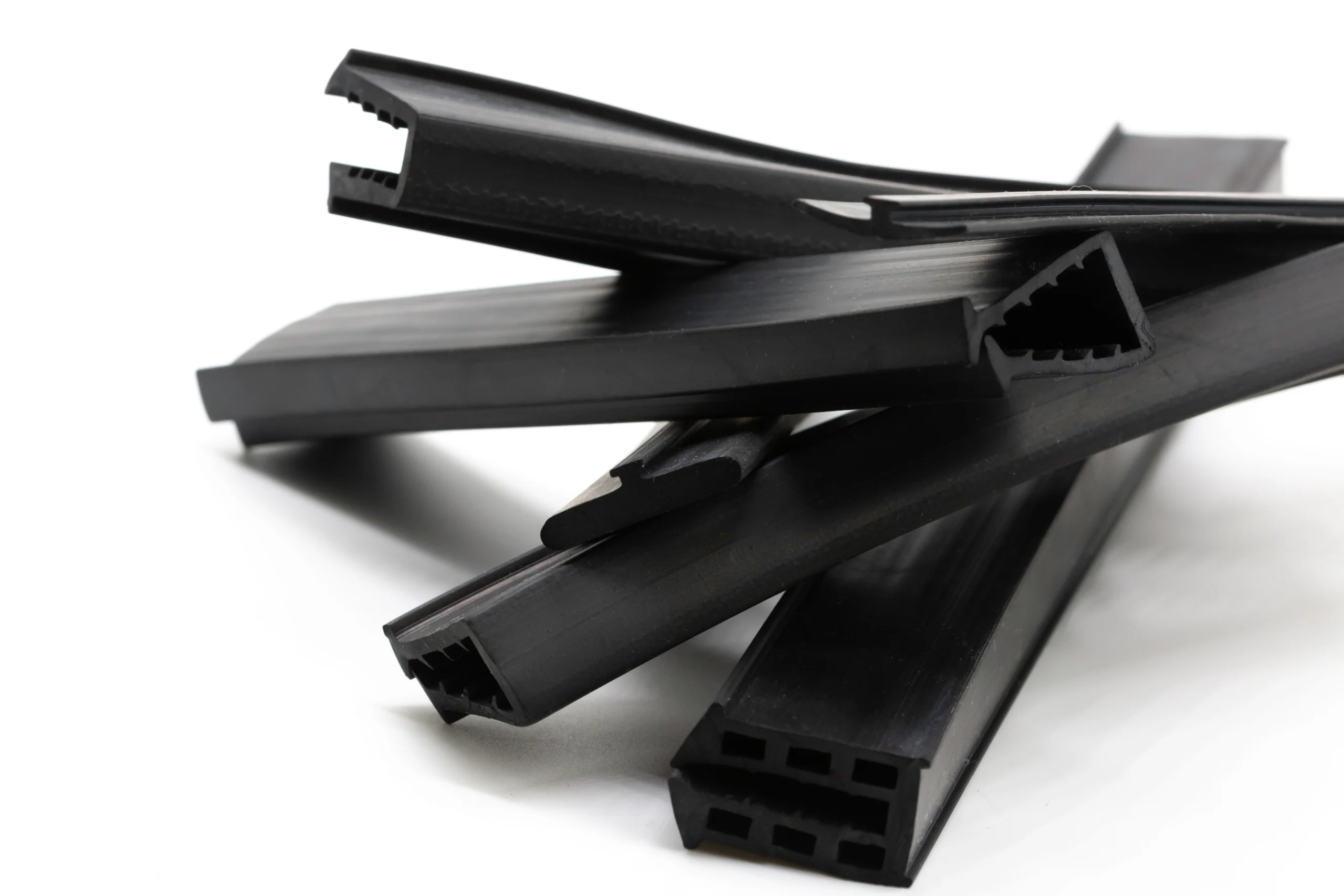
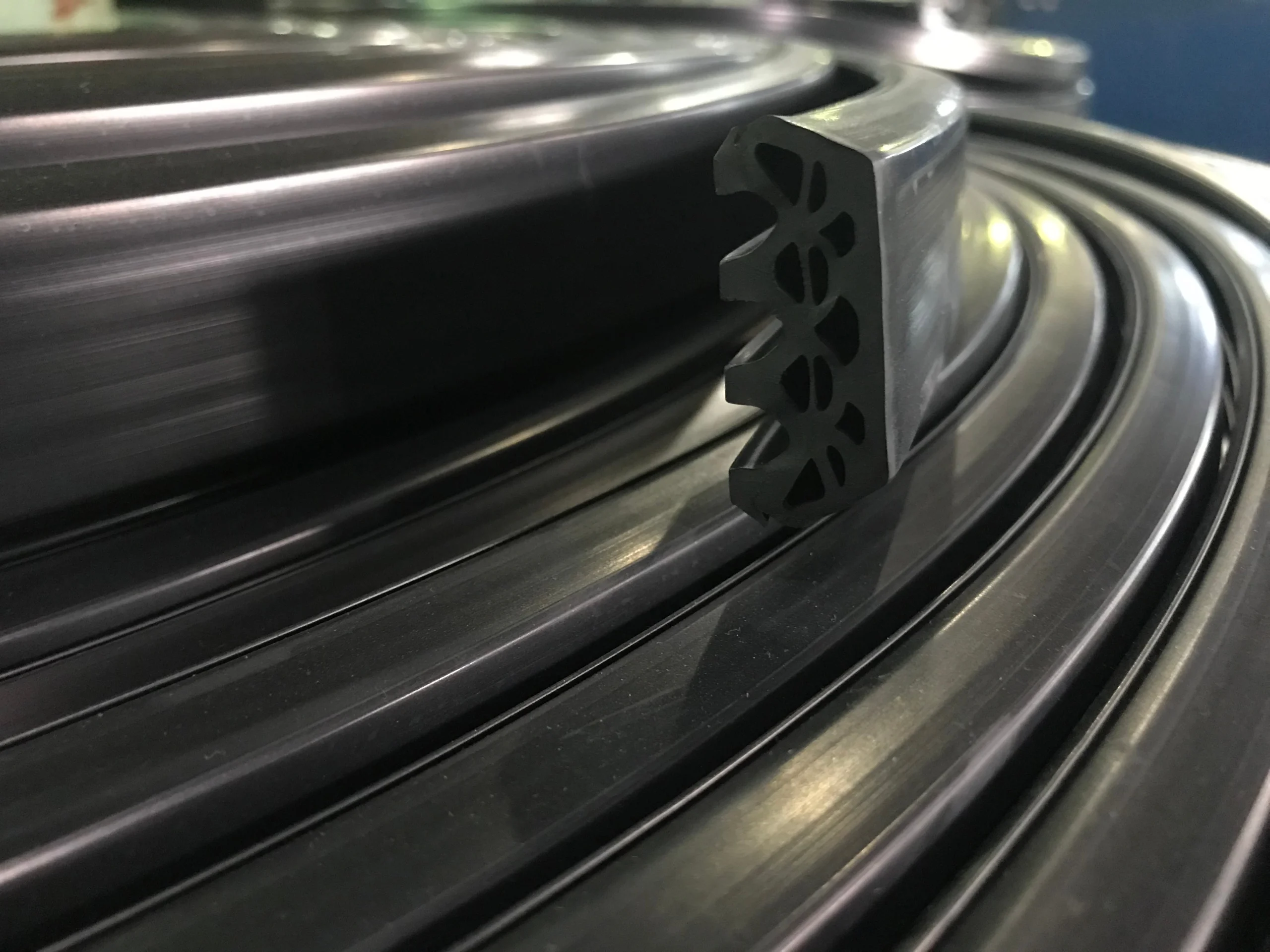
Extruded Door Seal EPDM 70 Shore A · Pune
Sponge Profile EPDM Sponge · Ludhiana
Window Seal TPV · Chennai
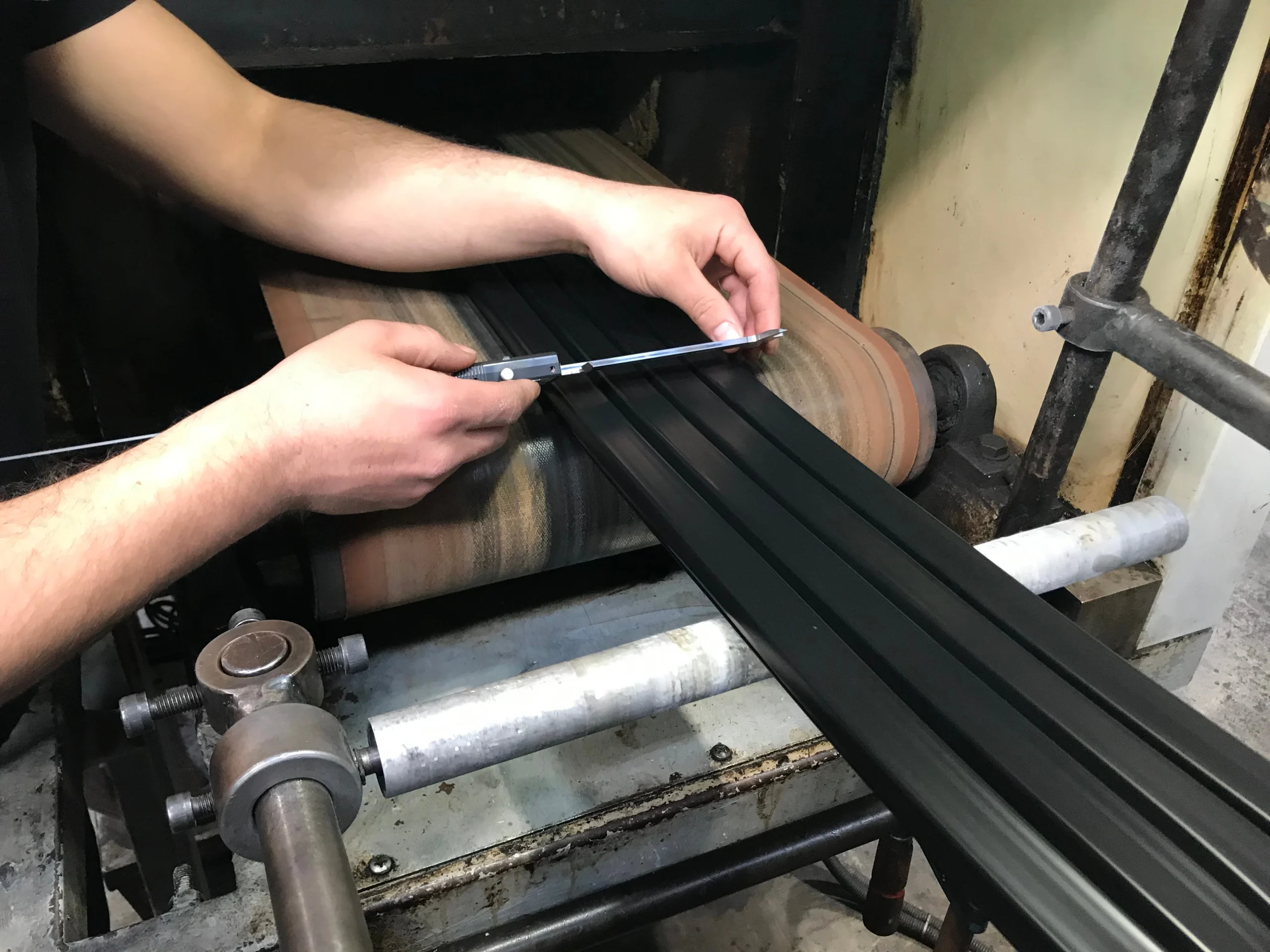
Operator gauging the cross section of an extruded rubber profile at the line at our India partner facility before the first PO
Before the first PO
Coiled extruded rubber profile on a reel at our India partner facility after the production run, batch volume in order
After production starts
Before the first PO

I walk the extrusion floor before a single PO is placed. We check the mixing mill and extruder against the compound, the cure line, the splice and mold shop, and the lab that will run your hardness and dimensional checks. We pick partners who run mixing, extrusion, curing, and finishing under their own roof, on their own QA team, on their own clock. One roof, one floor, one accountable team for the full rubber chain. DFM happens before a die is cut. DFM, first article, and PPAP validation gates come with photographic evidence, durometer and dimensional data, and a written verdict from our quality lead. Boots on the ground, every step of the way.

After production starts

My team runs weekly checks on hardness, cross section, cure state, and splice strength. We track SPC on durometer and key dimensions, compression set and ozone results on the compound, and lot to lot consistency on profile and color. We send you a status report every Friday that covers WIP, test results, die health, and shipping milestones. Carton and coil loading photos reach your inbox before the seal goes on. Every lot carries a traceability ID from compound batch to your receiving dock. Nothing ships until the dimensional report and the material test report both show green. We do not wait for you to ask. We report because that is how a rubber program should run.

Where the chain breaks.
And where we hold it.

Most contract manufacturers worldwide drop the ball at the handoff between two teams. We hold every one. Ten real stages, drawing to your dock. No sub-step skipped, no handoff left to chance.

Wide view of the rubber extrusion floor at our India partner facility, mixing extrusion and curing under one roof
01
Drawing intake + DFM
Break. Most suppliers quote in 7 days without a DFM pass. You find cross section and shrink issues at first article.
Hold. We run DFM inside 48 hours. Questions by email, not silence.
02
Quote + landed cost
Break. Suppliers quote factory price only. Duty, freight, surcharges land later, off-budget.
Hold. One total per piece. Tooling, freight, duty, inland. All in.
03
PO + tooling kickoff
Break. Kickoff slips two weeks while the supplier confirms specs. Your Gantt drifts on day one.
Hold. Kickoff call within 5 days of PO. Specs, gates, owners locked in writing.
04
Die + first article
Break. Die cut without a draw down check. The first you see of an undersize section is on the production lot.
Hold. Die and cured cross section reviewed with you before the run. Sign-off in writing.
05
First article gate
Break. Profile runs before a first article is signed. Hardness and cross section issues caught late.
Hold. First article signed before the run. Durometer and dimensional report archived.
06
Compound + scheduling
Break. Compound substituted without notice. Cert shows an SBR blend when drawing called EPDM.
Hold. Compound cert matched to drawing before the run. Batch number traced end to end.
07
Production run
Break. Status emails go quiet. You learn about the slip when the Gantt is already fiction.
Hold. Friday status report every week. SPC live, WIP visible, slips flagged early.
08
Cure + splice + finish
Break. Curing and splicing rushed. Compression set never runs. Splice strength verbal.
Hold. Curing, splicing, and finishing under one roof. Hot vulcanized splices pull tested. Compression set on every compound lot.
09
PPAP + quality release
Break. PPAP arrives partial. MSA missing. Production released on a verbal nod.
Hold. PPAP Level 3 full package. PSW signed by buyer before a single part ships.
10
Customs + US delivery
Break. Wrong HS code. Duty surprise on the invoice. Demurrage starts before anyone notices.
Hold. HS code locked at quote. Broker briefed. Container photos sent before seal.
Ten handoffs · One owner · Drawing to dock.
What rubber extrusion adds

Three things we control that a basic rubber shop skips.

A rubber profile is only as good as the compound, the cure, and the steps after the die. Most shops hand you loose extrusion and call it done. Three controls separate a rubber program that ships clean from one that ships you a reject report.

01 · Compound
Compounded to spec, not close enough.

We do not run whatever black compound is on the floor. The compound is mixed and tested to your ASTM D2000 line callout, durometer set on the cured sample, and oil, heat, and ozone resistance matched to the application. Every batch carries a rheometer cure curve and a hardness check before it reaches the die. Peroxide or sulfur cure is chosen for the duty, not for the shop habit.

02 · Cure and splice
Cured and spliced to hold.

Continuous vulcanization by hot air, salt bath, or microwave sets the cure state the same way every run. Sealed corners and rings are hot vulcanized, not glued, then pull tested. Compression set per ASTM D395 and ozone per ASTM D1149 run on the compound, with heat aging per ASTM D573. A seal that takes a set or cracks at the splice never reaches your dock.

03 · Gates
No run ships without a gate.

DFM and cross section check. First article off the die, durometer and dimensional on the cured profile. PPAP production sign off. Each gate carries a checklist, photos of the profile, and the sample side by side with the print. A run that starts without a first article is a run that drifts on hardness and section. We catch it on the bench, not on your line. Dimensional and material test reports run on every production lot before it ships.

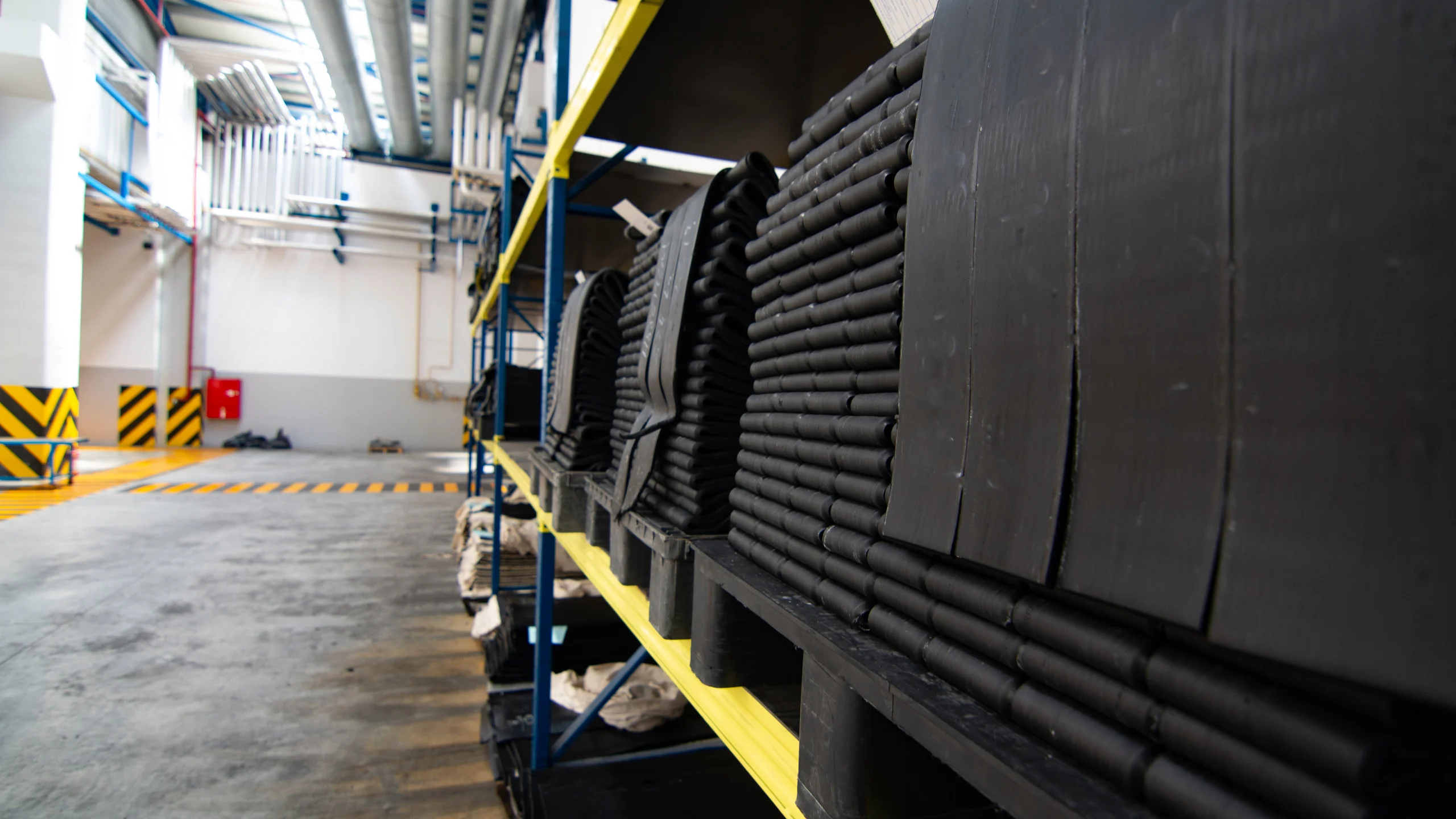
Extruded rubber profiles stacked on warehouse racks down a long aisle at our India partner facility, where we walk the line before a single PO

What we do not doon a rubber extrusion program.

We are not a marketplace. We do not match you with a supplier list and call it done. Every rubber partner on your program is selected, audited, and managed by our team on the ground in India.
We do not hand you a quote and disappear. From drawing intake through dock delivery, one owner stays on your program. Every handoff is documented. Every Friday status update is sent without you asking.
We do not send your parts to a line we have not personally walked. Our team audits the floor, the mixing mills, the extruders, the cure lines, the mold shop, the tool room, the SPC charts, and the people before a single PO is placed.
We do not use your drawings, tooling, or specs to make parts for anyone else. Your design stays your design. Your dies and molds stay yours. Die and mold ownership transfers to you on full payment, in writing.
We do not promise a compound or a cure without proof. Durometer and tensile to ASTM D412 on first article. Compression set per ASTM D395 and ozone per ASTM D1149 on the compound. If we cannot show it, we will not ship it.
We do not claim to own the floor. We own the outcome. The lot ID, the Friday update, the PPAP package, and the part landing on your dock on time. That is the whole job.

On the extrusion floorbefore you ask.

Most India sourcing is run from a laptop in Cincinnati. Ours is not. Our team is physically present at partner facilities for first article reviews, cure and splice sign offs, and production launches. When something slips, we see it before you do. When quality holds, we have the photo evidence to prove it.

22+ Indian manufacturing cities. 40+ qualified rubber partner facilities. Real people on the floor making sure your drawing becomes a profile that passes PPAP the first time.

Pune Coimbatore Rajkot Chennai Ludhiana Faridabad Aurangabad Ahmedabad Mumbai Delhi NCR Bengaluru Hyderabad Kolhapur Belgaum Nashik Jalandhar Batala Howrah Vadodara Jamshedpur Kolkata Indore Nagpur
Worker on the rubber extrusion floor handling a large cured profile during a facility visit at our India partner plant
First article molded rubber parts laid out for inspection at our India partner facility
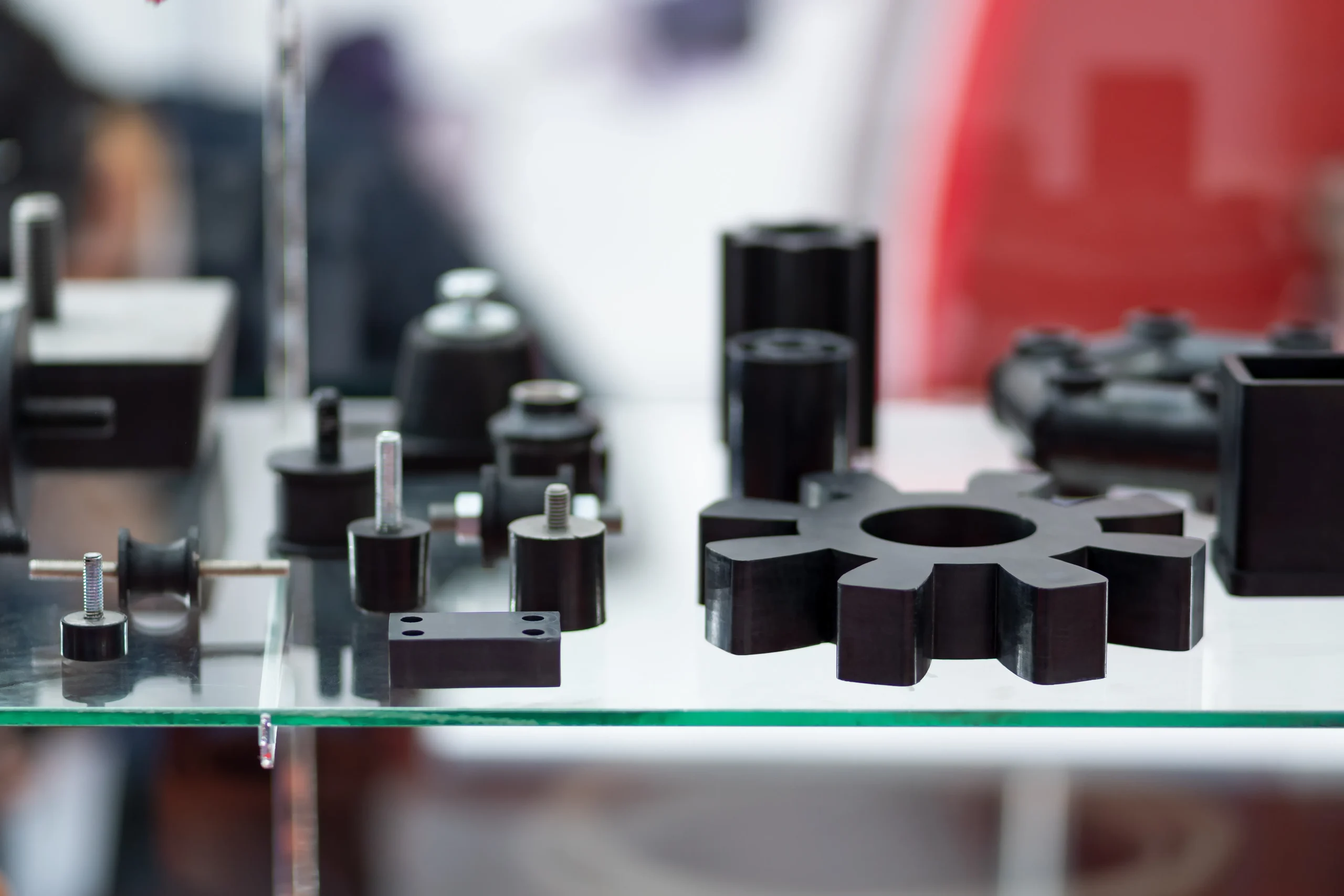
Molded rubber vibration mounts and a coupling insert on the floor at our India partner facility

Inside our India rubber network.

22+ cities. 40+ audited rubber partners across extrusion, co-extrusion, compression and injection molding, and splicing. Hover any marker to see partner count and what runs there.

Pune 5+ partners
Extrusion and molding · auto seals · tier 1
Chennai 4+ partners
Auto OEM tier · port hub · seals and mounts
Gurgaon Manesar 4+ partners
Maruti ecosystem · auto rubber parts
Faridabad 3+ partners
Extrusion · auto tier 1 · rubber seals
Delhi NCR 3+ partners
Rubber · electronics gaskets · molded
Ludhiana 4+ partners
Rubber hub · auto and agriculture · mounts
Rajkot 3+ partners
Rubber · seals · pump and valve parts
Bengaluru 4+ partners
Electronics gaskets · silicone · precision
Pithampur 2+ partners
Pithampur auto cluster · rubber parts
Aurangabad 2+ partners
Auto rubber parts · grommets · sub assembly
Coimbatore 3+ partners
Pumps · motors · seals · gaskets
Ahmedabad 2+ partners
Extrusion · seals · molded parts
Nashik 2+ partners
Molding · auto seals · grommets
Mumbai 2+ partners
Logistics hub · Nhava Sheva port · consolidation
Hyderabad 2+ partners
Precision silicone · electronics · gaskets
Howrah Kolkata 2+ partners
Heavy rubber · industrial profiles
Vadodara 2+ partners
Rubber extrusion · industrial seals
Jamshedpur 1+ partners
Industrial rubber · molded and extruded

22+ cities  ·  40+ rubber partners  ·  20A to 90A durometer range

On the floor in India today.
Real people, real presses, across 22 plus cities, with one named owner on your program. Send your drawing and we take it from there.
Submit RFQ

FIVE RUBBER PROCESSES
WE RUN FROM INDIA.

Extrusion and co-extrusion push a profile through a die. Compression and injection molding form the parts a die cannot. Splicing and vulcanizing close a profile into a sealed ring. All of it runs through one VIA INDIGOS playbook. One owner from drawing to dock. One status update every Friday. One India network of 40 plus audited partner facilities behind every program.

Extrusion
Profile extrusion

Continuous seals, gaskets, tubing, and custom profiles pushed through a steel die, then cured inline. The fast, low tooling path from a cross section drawing to a running profile. EPDM, silicone, NBR, and more.

Tolerance
ISO 3302 E2
Hardness
20 to 90 Shore A
Co-extrusion
Dual durometer co-extrusion

Two compounds in one profile from one pass. A soft sealing lip on a rigid carrier, or a dense skin over a sponge core. The compounds cure together as one part, bonded, not glued.

Streams
2 to 3 compounds
Bond
cured, not glued
Compression
Compression molding

Molded seals, grommets, bumpers, end caps, and corner joints formed in a heated cavity. The right route for thick sections and lower volumes that an extrusion die cannot make.

Cavities
1 to 50
Cure
press and heat
Injection
Rubber injection molding

Higher volume molded parts with fine detail and tight flash control. Compound is injected into a heated mold and cured fast, lot after lot, to an ASTM D2000 line callout.

Volume
5k to 1M pc/yr
Spec
ASTM D2000
Splicing
Splice and vulcanize

Extruded profile cut and joined into sealed rings and frames. The joint is hot vulcanized to the same compound and pull tested, so the corner holds under pressure and weather instead of letting go in the field.

Joint
hot vulcanized
Test
pull tested
Which rubber process for your part

Rubber process comparison · cost, volume, lead time.

Extrusion vs co-extrusion vs compression vs injection vs splicing. Five honest comparisons, not marketing claims. Use this to short list before you send the cross section.

DWG 001 · REV A SCALE 1:1

EXTRUSION

Volume 500 to 5,000,000ft/year
Lead time 2 to 4weeks, die build
Section 1 to 50mm wide
Tolerance ISO 3302-1class E2
Tooling LOW
Pick this when

Continuous seals, gaskets, tubing, profiles.

DRAWNVI ENG CHKDMS UNITSMETRIC
DWG 002 · REV A SCALE 1:1

CO-EXTRUSION

Volume 500 to 3,000,000ft/year
Lead time 3 to 5weeks, die build
Streams 2 to 3compounds
Tolerance ISO 3302-1class E2
Tooling MEDIUM
Pick this when

Dense plus sponge, hard carrier plus soft seal.

DRAWNVI ENG CHKDMS UNITSMETRIC
DWG 003 · REV A SCALE 1:1

COMPRESSION MOLD

Volume 100 to 100,000pcs/year
Lead time 4 to 6weeks, mold build
Cavities 1 to 50per tool
Tolerance ±0.10 to ±0.30mm
Tooling MEDIUM
Pick this when

Molded seals, grommets, bumpers, corners.

DRAWNVI ENG CHKDMS UNITSMETRIC
DWG 004 · REV A SCALE 1:1

INJECTION MOLD

Volume 5,000 to 1,000,000pcs/year
Lead time 6 to 10weeks, mold build
Flash tightdeflashed
Tolerance to ASTMD2000
Tooling HIGH
Pick this when

High volume molded parts, fine detail.

DRAWNVI ENG CHKDMS UNITSMETRIC
DWG 005 · REV A SCALE 1:1

SPLICE & CURE

Volume runs withthe profile
Lead time withextrusion
Joint hotvulcanized
Strength pulltested
Tooling LOW
Pick this when

Rings, frames, sealed corners from profile.

DRAWNVI ENG CHKDMS UNITSMETRIC

Not sure which fits? Send the cross section and we recommend the right process for your section, volume, and durometer, and quote both options where it makes sense.

Forming and curing

CONTINUOUS EXTRUSION AND VULCANIZATION.

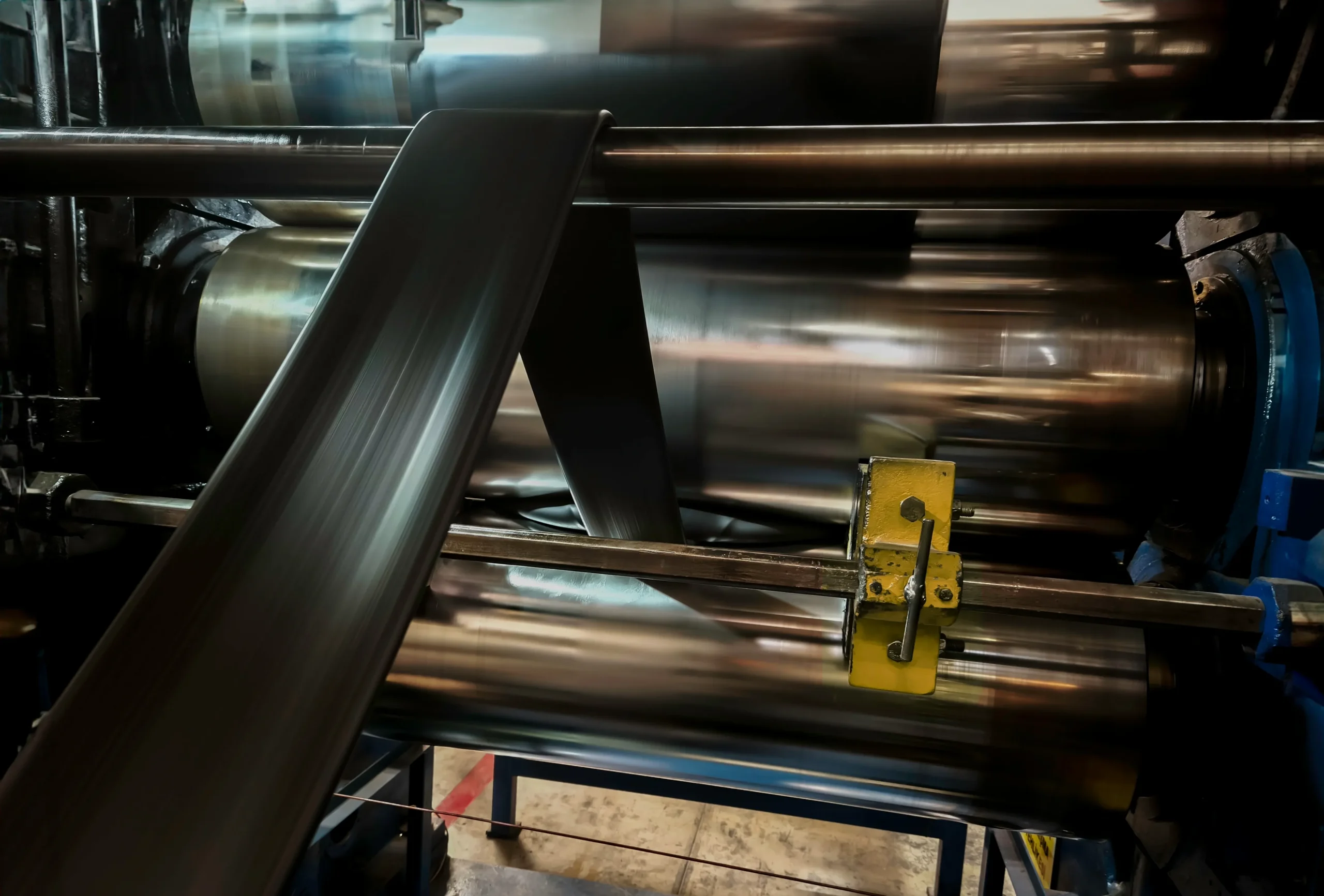
An extruded profile is only as good as its cure. Raw compound goes through the die soft, then sets its shape and hardness in the cure line in one continuous pass. We run hot air, salt bath, and microwave cure lines at partner facilities, then check section and durometer before the profile ships.

Cured rubber profiles coming off the continuous extrusion line at our India partner facility
Extruded rubber profiles running in production on the cure line at our India partner facility
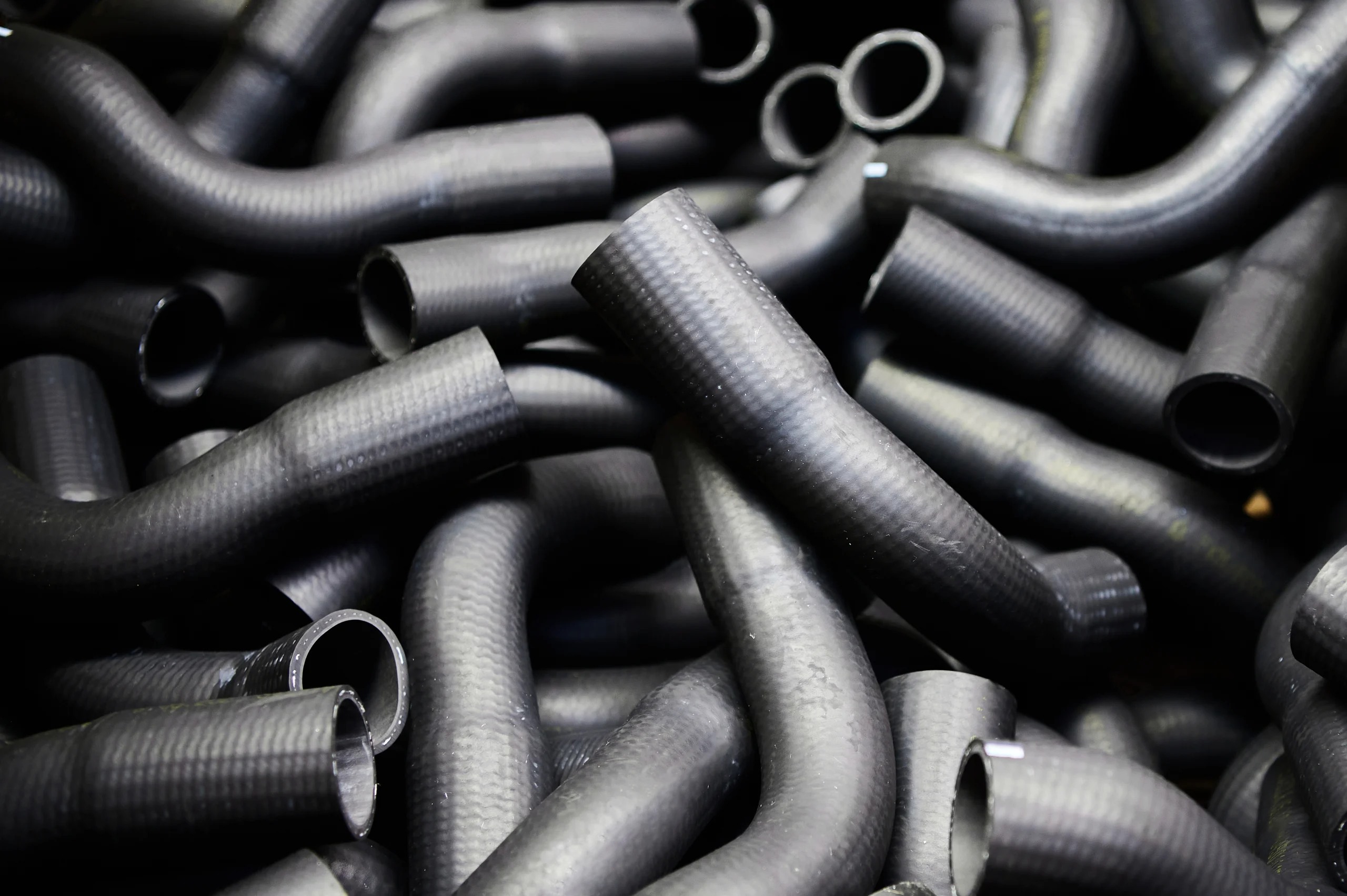
Extruded rubber hose and tubing after vulcanizing at our India partner facility
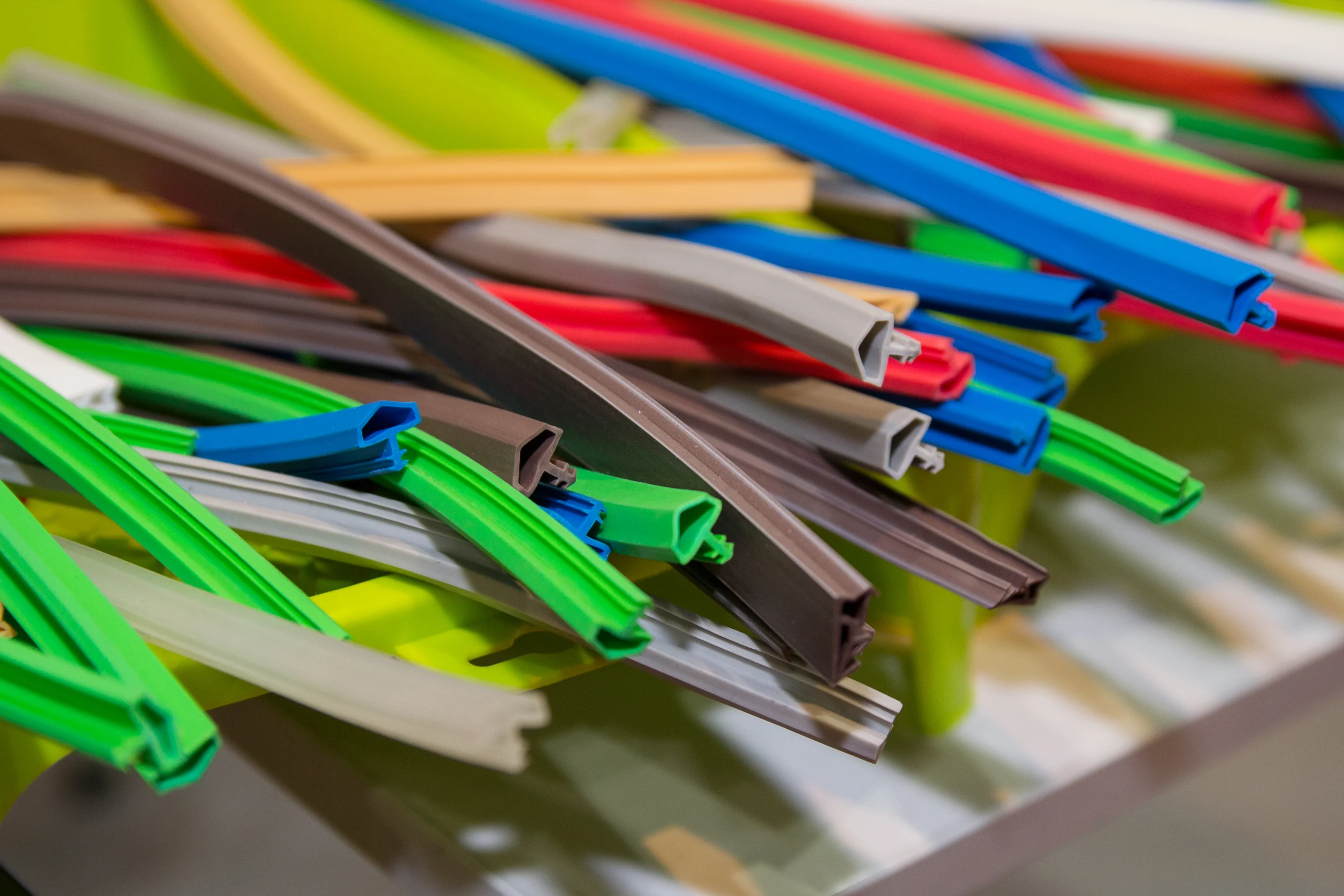
Colorful co-extruded rubber profiles in dense and sponge sections at our India partner facility
Cure method Mode Typical compounds Section range Typical use
Hot air vulcanizing (HAV) Continuous EPDM, silicone 1 to 30 mm Dense profiles and lip seals
Salt bath (LCM) Continuous EPDM, NBR, CR 2 to 40 mm Solid and complex sections
Microwave (UHF) and HAV Continuous EPDM sponge and dense 3 to 50 mm Sponge and co-extruded profiles
Steam autoclave Batch Most compounds Tube and cord Tubing, cord, wrapped hose
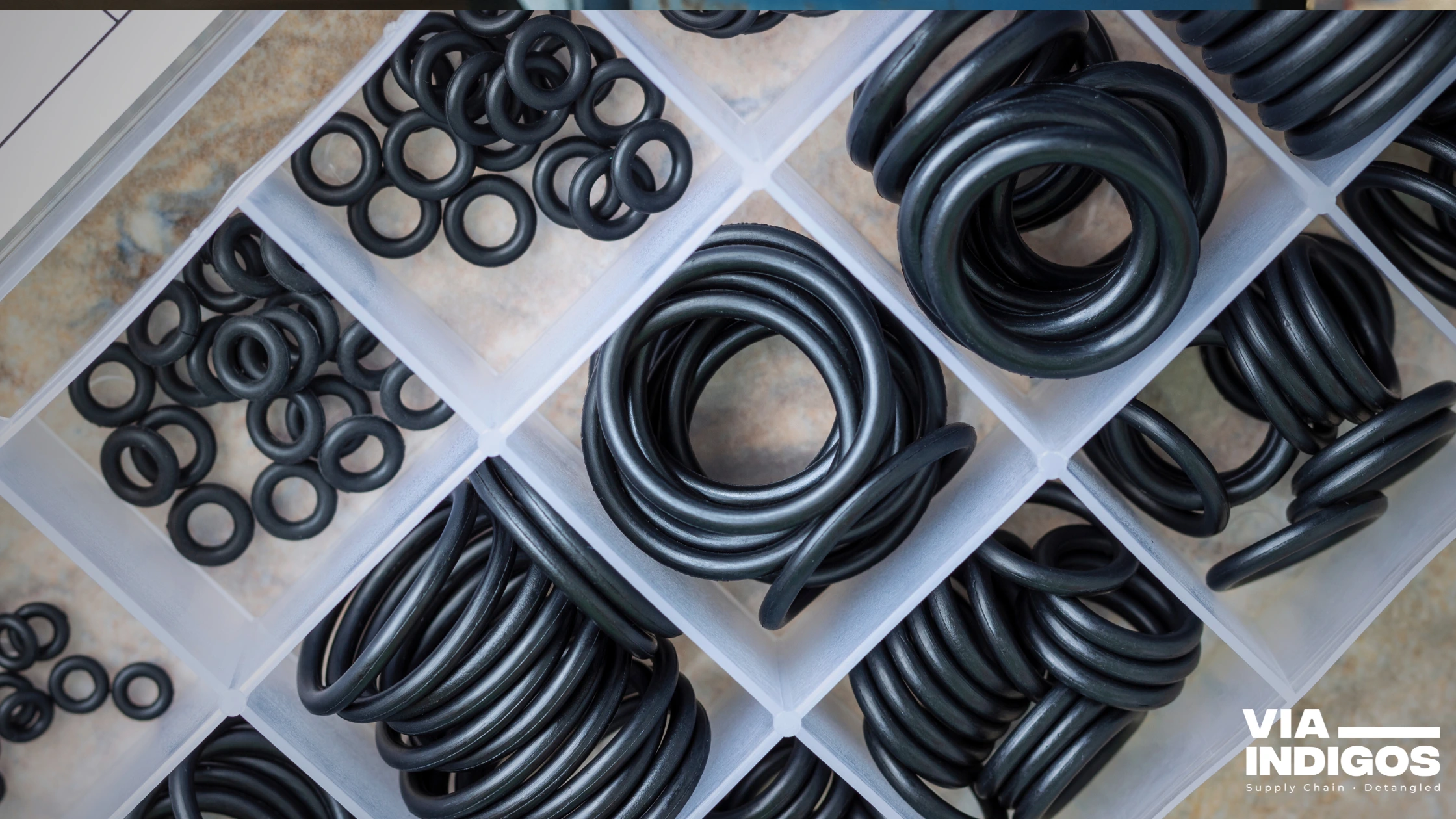
Hot vulcanized splice Joint Matched compound Ring and frame Sealed corners, O-rings, gaskets

Every profile cross section is checked against the print, and durometer is verified off the cure line. Splices are pull tested before a sealed ring ships. Dies are cut and held at the partner facility so the section runs the same way every time.

Molded rubber

MOLDING UNDER ONE ROOF.

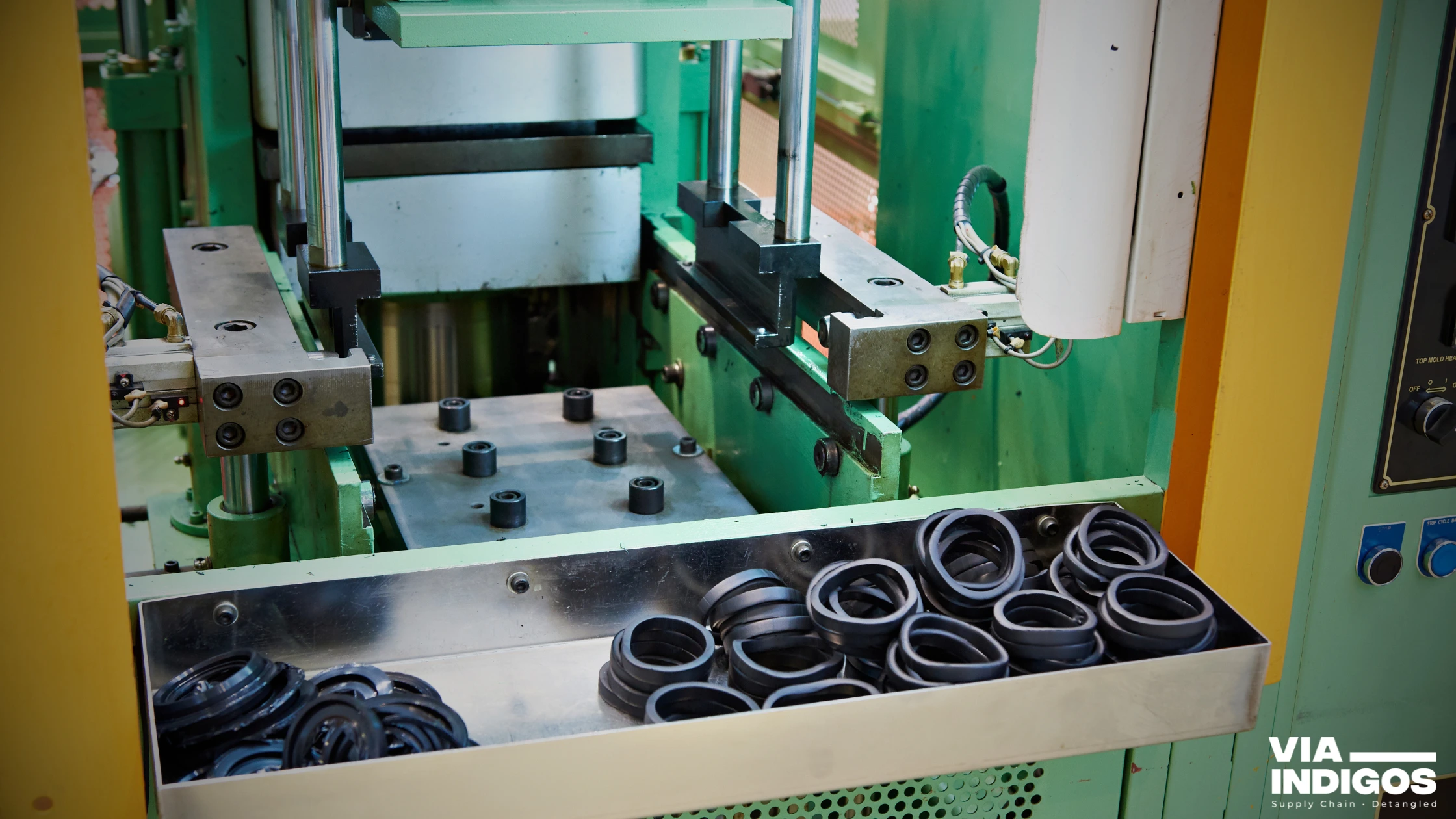
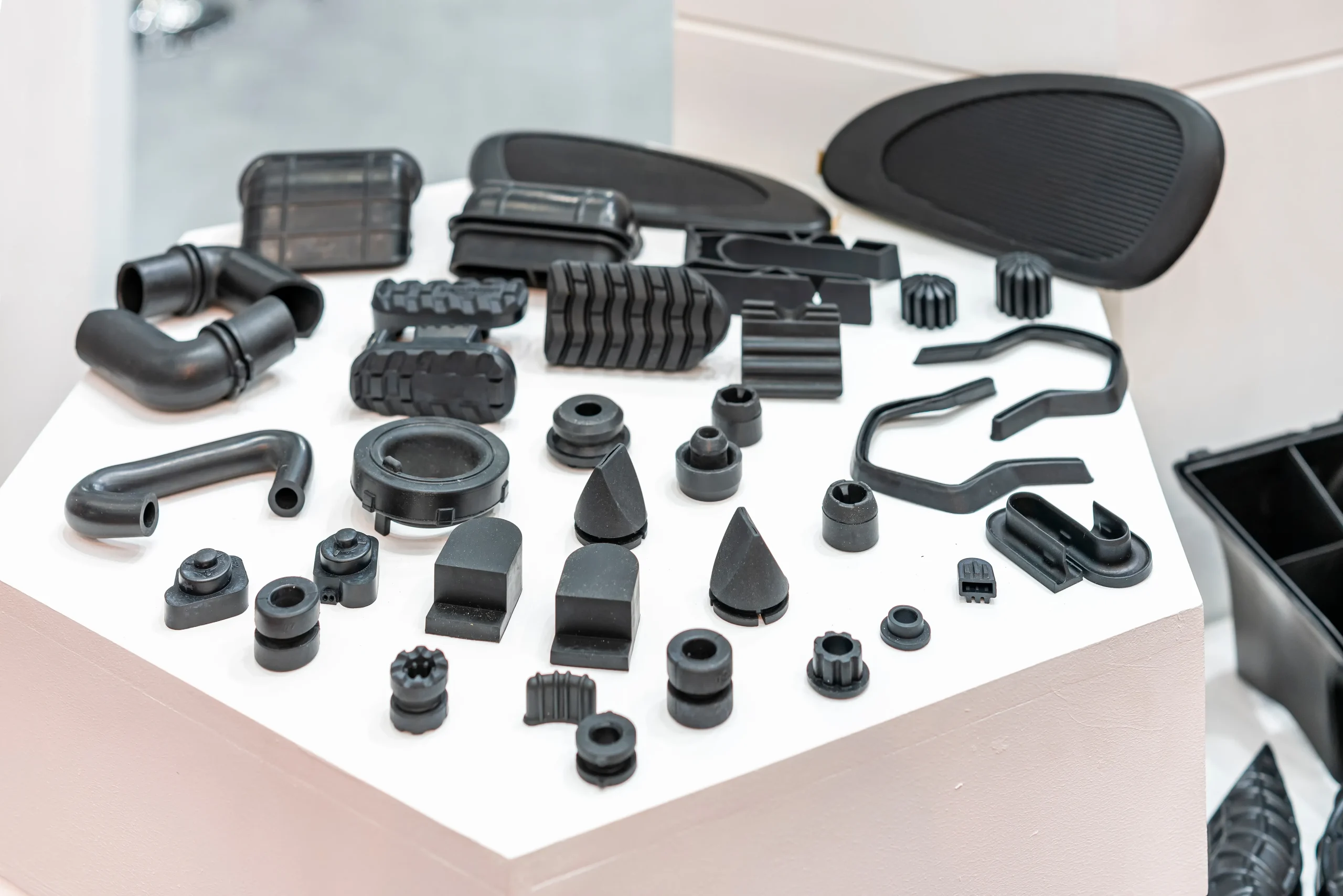
Some parts a die cannot make. Bellows, mounts, grommets, bumpers, and seals with corners need a mold. So molding sits next to extrusion under the same owner, not a shop you chase later. We run compression, transfer, and injection molding through partner plants, and every part is checked against ASTM D2000 and the print before it ships.

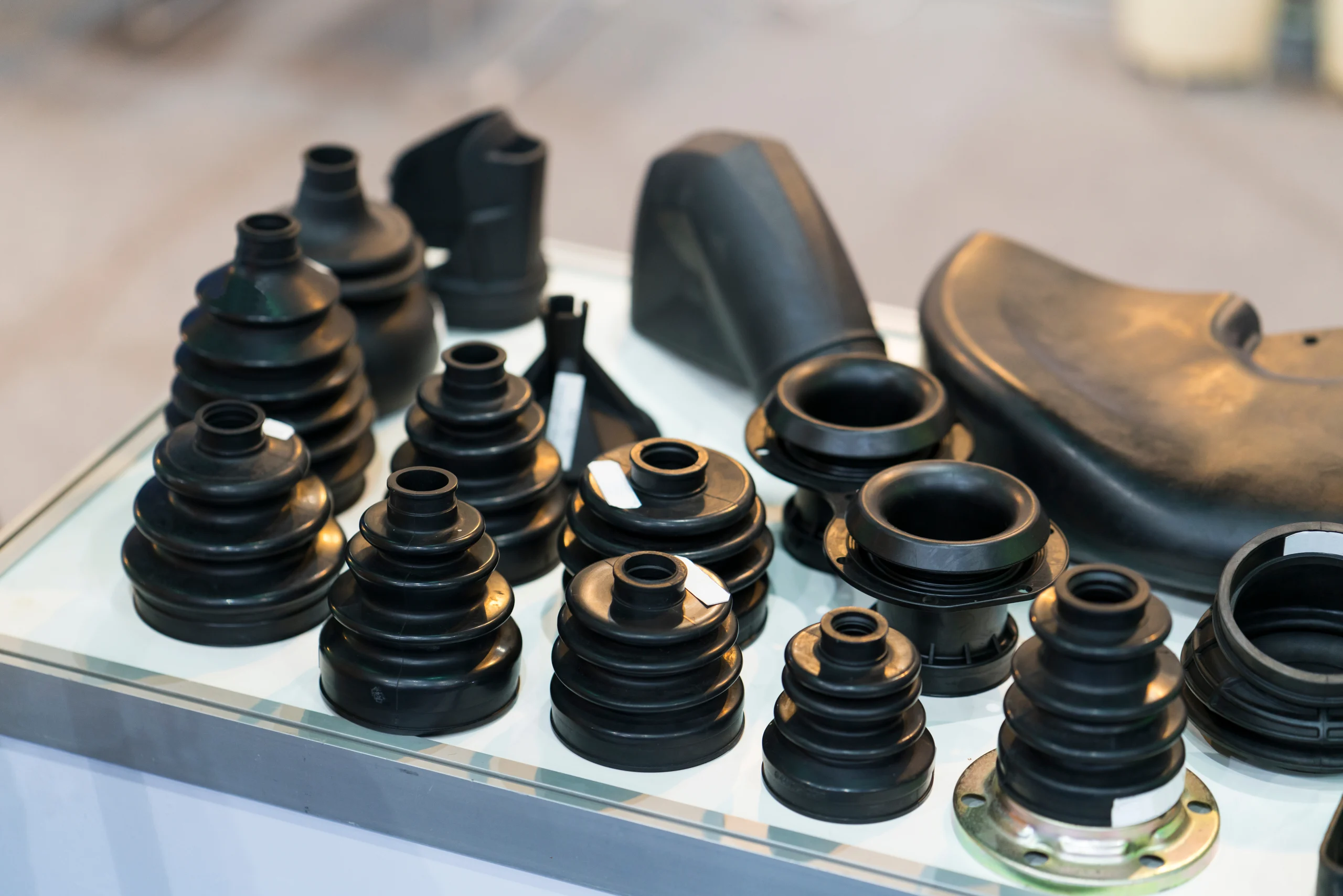
Precision molded rubber boots and bellows laid out after curing at our India partner facility
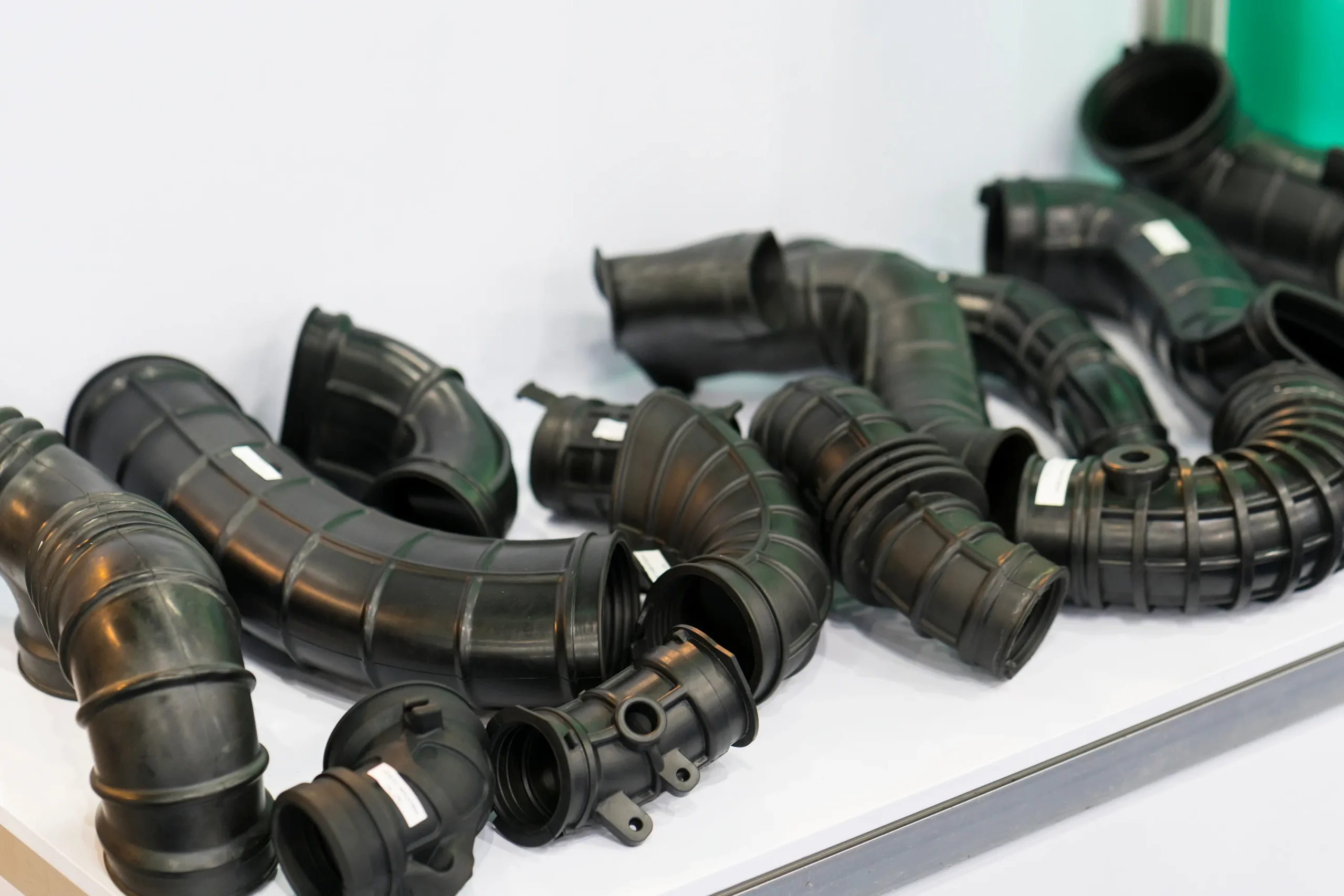
Molded rubber air intake bellows with corrugated flex sections for automotive engines at our India partner facility
Molded rubber vibration mounts and a flexible coupling spider insert at our India partner facility
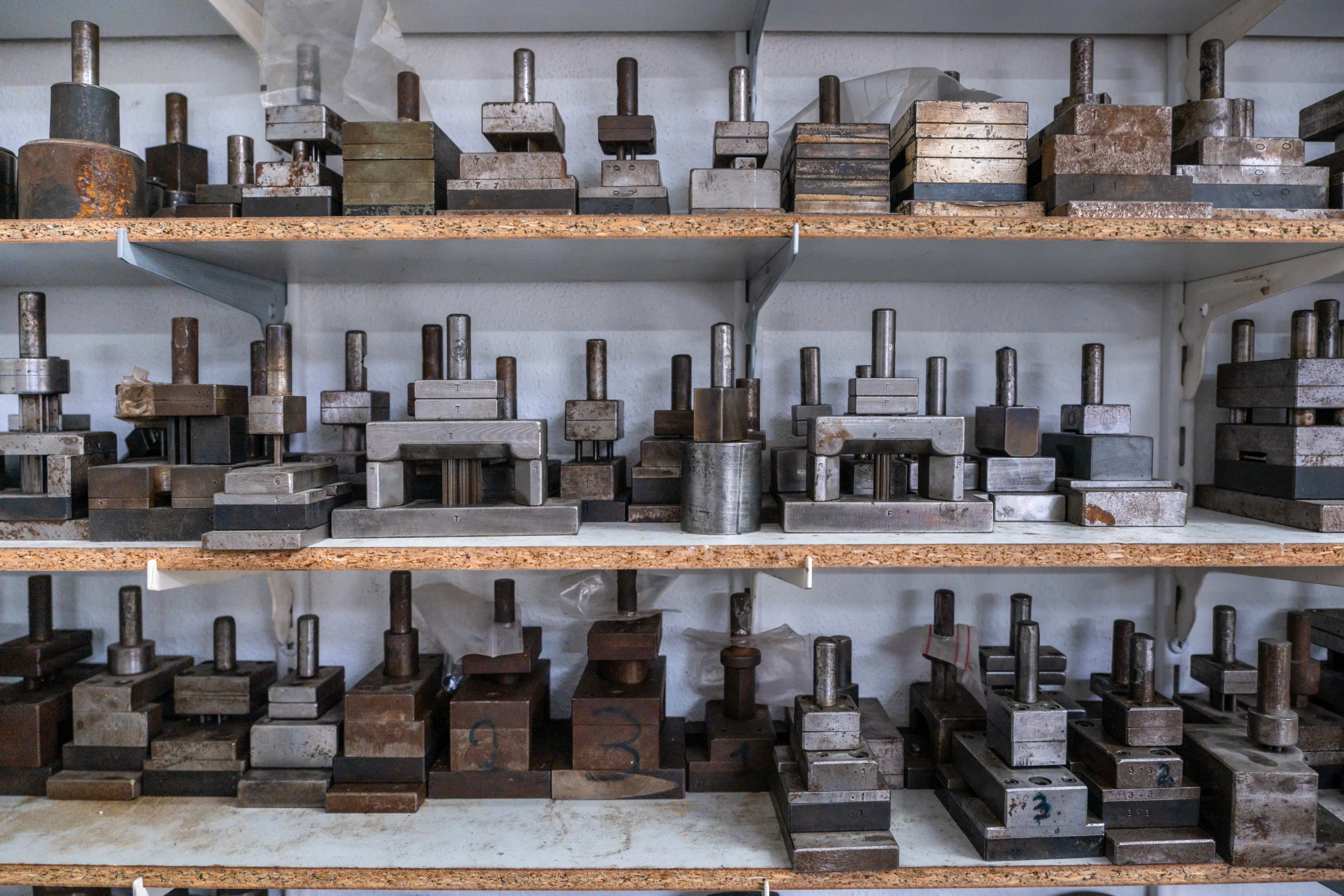
Rubber molds and tooling on the shelf at our India partner facility, ready for the next run
Molding How it runs Typical spec Notes
Compression molding Preform cured in a heated cavity ASTM D2000 Low to mid volume, thick or large parts
Transfer molding Compound forced from a pot ASTM D2000 Inserts and tighter dimensions than compression
Injection molding Screw injects into a closed mold ASTM D2000 High volume, fine detail, low flash
Insert and over molding Rubber bonded to metal or plastic ASTM D429 bond Mounts, bushings, bonded seals on carriers
LSR molding Liquid silicone dosed and cured ISO 3302 Medical and food grade silicone parts

Post cure, flash trimming, surface coating, and bonded metal inserts run through the same partner network. We confirm the compound, durometer, and any bond callout during DFM review, and the test report goes in the PPAP file.

Share your rubber extrusion project today.
A drawing, a sample, or a sketch is enough to start. Send what you have and get a real read on tooling, durometer, and landed cost.
Submit RFQ
Build discipline

DFM . FAI . PPAP .
NO RUN SHIPS WITHOUT A GATE.

Three gates, three sign offs, photo evidence at every step. We do not move a part forward unless the gate before it is closed. A run that starts without a first article is a run that drifts on hardness and section, and we would rather catch it on the bench than on your line.

DFM
Rubber cross section and die drawing reviewed against the sample during DFM at our India partner facility
Gate one
Cross section ready

The cured cross section is checked back to the drawing. Draw down and shrink set, die cut and trialed. Wall, corner radius, and durometer target all signed off before the first production foot.

  • Cross section vs drawing and sample
  • Draw down and shrink allowance set
  • Compound and durometer confirmed
  • Photo set archived in the project file
FAI
Durometer and dimensional check on a cured rubber profile during first article inspection at our India partner facility
Gate two
First article on cured profile

The first profile off the die. Full dimensional report on the cured cross section, durometer on the cured sample, tensile and elongation to ASTM D412. Splice strength checked where the part is joined. Report to you before the next run.

  • Cured cross section dimensional report
  • Durometer to ASTM D2240
  • Tensile and elongation to ASTM D412
  • Buyer engineering call before PPAP
PPAP
PPAP sign off, production batch of extruded rubber window seal profiles stacked at our India partner facility
Gate three
Production sign off

PPAP package complete. PSW signed by the buyer. Compound certificate and ASTM test results on file, capability on critical dimensions above Cpk 1.67. Lot traceability live to the compound batch. Production releases only after the buyer has the full PPAP package in hand.

  • PPAP Level 3 package signed off
  • Compound cert and ASTM D2000 results
  • Compression set and ozone on the lot
  • Lot traceability ID assigned
From your drawing to your dock

One owner runs your whole rubber program,
drawing to dock.

A rubber program that runs across two countries, three suppliers, and a dozen handoffs is going to break unless someone owns every step. Below is what your program looks like under one VIA INDIGOS owner, end to end.

01
Drawing intake
PDF, STEP, DXF. NDA signed first.
02
DFM review
Cross section, wall, corner radius, durometer.
03
Quote with TCO
Part, tooling, freight, duty, all in.
04
Die and extrude
Die cut, line set, first article off the die.
05
Quality gates
DFM, first article, PPAP with photo evidence.
06
Production run
SPC live. Friday status report.
07
QC and inspection
Durometer, tensile, section, cut length.
08
Container loading
Photos, lot IDs, paperwork pack.
09
US dock delivery
JIT or warehouse. Door to door.
One accountable owner. Every step. Every program.
The numbers we run by

RUBBER QUALITY AND TESTING.

If a metric does not have an owner, a target, and a data source, it is not a metric. Below is the scoreboard we run on every rubber program, refreshed weekly, surfaced in your Friday status email.

Submission
Level 3
PPAP every program
Full PSW with capability studies, MSA, and dimensional report.
First pass
≥ 95%
FPY at PPAP
Parts accepted at first submission divided by parts submitted.
On time
≥ 98%
OTD to dock
Promised date versus delivered date at customer dock.
Defect rate
< 500 ppm
Incoming defect
Buyer incoming inspection rejects per million parts shipped.
Capability
Cpk ≥ 1.67
Critical features
Process capability index on every customer flagged critical dimension.
Cost of poor quality
< 1%
COPQ of spend
Total scrap, rework, returns, and warranty claims as percent of program spend.
Traceability
100%
Lot to compound
Compound batch traced from the mixing lot through extrusion, cure, and splice, to your dock.
Material testing
ASTM
Durometer and aging
Durometer D2240 and tensile D412 on first article. Compression set D395 and ozone D1149 on the compound.
What we mould and extrude

Rubber compoundswe run.

The right compound is half the part. We run the common families across dense, sponge, and liquid silicone, chosen for heat, oil, weather, and the duty the seal sees. Below is the working range. A compound certificate travels with every batch so the mix traces back to the part.

Compound Common types Shore A range Key properties Typical parts
EPDM Dense, sponge, peroxide 40 to 90A Weather, ozone, steam, coolant Door and window seals, weatherstrip
Silicone (VMQ) Dense, sponge, LSR 20 to 80A Heat and cold, food and medical High temp seals, gaskets, tubing
Nitrile (NBR) Dense 40 to 90A Oil and fuel resistance Fuel seals, oil gaskets, grommets
HNBR Dense 50 to 90A Oil plus heat and abrasion Engine seals, high stress gaskets
SBR Dense 40 to 80A Abrasion, low cost general use Pads, bumpers, general profiles
Neoprene (CR) Dense, sponge 40 to 80A Weather, moderate oil, flame Marine seals, gaskets, bellows
FKM (Viton) Dense 60 to 90A High heat, fuel, chemical Fuel system seals, O-rings
Natural rubber (NR) Dense 30 to 90A High strength and resilience Mounts, bushings, anti-vibration
Polyurethane (PU) Dense, cast 70A to 95A Abrasion, load, tear strength Wheels, rollers, heavy duty pads
Shore A hardness · soft to hard
Foam & sponge
~30A
Weatherstrip & seals
~60A
Wear pads
~85A
20A40A60A80A90A
20 to 40A
Soft sponge seals, foam profiles, soft grommets.
50 to 70A
Most weatherstrip, gaskets, O-rings, common seals.
75 to 90A
Hard profiles, bushings, wear pads, structural seals.

Reading an ASTM D2000 callout. A line like M2BC714 A14 B14 sets the rules. M is metric. The type letter and class letter name the polymer family by heat and oil resistance. 7 is durometer in tens, so 70 Shore A. 14 is the tensile grade. Each suffix such as A, B, or C adds a tested requirement like heat aging, compression set, or fluid swell. Send the callout and we match the compound to it.

Other compounds and colors run on request. Hardness range depends on the compound and the section. We confirm compound, durometer, and cure during DFM review before quote, and the compound certificate goes in the PPAP file.

Racks of extruded rubber profiles coiled and stacked ready to ship, where design for logistics cuts freight cost to your US dock
Cheaper to move

Design for logistics.

A profile can pass every check and still cost too much to ship. Rubber is light but bulky, so freight is set by volume, not weight. We look at the profile and the pack together, before the die is cut, so the same part fills more of the container and clears customs faster.

Coiling
Coil long profiles on reels so a carton holds more feet and freight drops per foot.
Cut length
Cut to length and nest in the carton instead of shipping loose coil that wastes container space.
Labeling
Right dunnage, stackable cartons, and labels that match your PO. Faster customs, fewer line errors at your dock.
Submit your RFQ

Send your rubber drawing.
Get a full landed cost.

Upload your drawings. We review, run DFM, and return a full landed cost breakdown with tooling timeline and PPAP scope. You get one contact from intake to ship.

We respond within 24 hours. Your drawings are never shared with third parties. Mutual NDA available on request.

Same playbook · eleven verticals

Eleven industries we make rubber parts for.

Every industry has its own certs, its own regulatory pressure, its own drawing conventions. The handoff discipline stays the same. What changes is the technical documentation that moves with the part.

Beyond rubber extrusion

Capabilities Beyond Rubber Extrusion.

Rubber extrusion questions we getevery week.

Plain English answers, written for procurement and engineering teams who want a real number, not a brochure. Last reviewed by Mandeep Singh in May 2026.

EPDM, silicone, NBR, HNBR, SBR, neoprene CR, FKM Viton, natural rubber, and polyurethane, from 20 to 90 Shore A. Dense, sponge, and liquid silicone all run. Tell us the ASTM D2000 callout or the application and we confirm the compound during DFM review.

Color, cure system, and food or medical grade are set on the same call, so the first article matches the spec, not a guess.

Rubber holds wider than metal because it shrinks and relaxes as it cures. Cross section runs to ISO 3302-1 class E2, roughly plus minus 0.4 mm on small sections and wider as the section grows. Hardness holds to plus minus 5 Shore A.

Cut length follows the RMA handbook by length band. If a print calls metal tolerances on a rubber part, we flag it at DFM and propose a class the process can actually hold.

An extrusion die runs 2 to 4 weeks. A first article off the die lands in 4 to 6 weeks from PO, depending on compound, cure, and splicing. Production runs land in 5 to 8 weeks.

Molded parts add time for the mold build. We give you the die and first article dates in writing at quote, not a vague promise.

Once the die exists, minimums are by weight, often a few hundred kilograms or a few thousand feet per release. We set a minimum order value rather than a piece count so small profiles still pencil out.

Tell us the section and the annual volume and we tell you the run size that makes the price work.

Durometer to ASTM D2240, tensile and elongation to ASTM D412, compression set to ASTM D395, ozone to ASTM D1149, heat aging to ASTM D573, and fluid swell to ASTM D471.

Cross section and cut length are checked on every lot, and the test report goes in the PPAP file. If we cannot show it, we will not ship it.

Yes. We hot vulcanize splices for sealed corners and rings, not glue. The joint is cured to the same compound and pull tested, so it holds under pressure and weather instead of letting go in the field.

Molded corners and injection molded joints are options too, when the part needs a clean geometry at the seam.

You do. Die and mold ownership transfers to the buyer on full payment, in writing, with a tooling passport that records die ID, build history, and storage location. We hold the die at our partner facility on a bailment basis.

If you want to move programs later, the tooling is yours. We do not lock dies to facilities or hold them hostage.

Last call

Your rubber profiles are
worth a free quote.

Send us your drawings. You get a full landed cost breakdown, a tooling timeline, the recommended rubber process, and a PPAP scope. One contact from intake to ship. No commitment required.

30 minutes · no obligation · bring your drawings

This website stores cookies on your computer. Cookie Policy