
Automotive Rubber Extrusion: EPDM Profile Sourcing Guide

An RFQ for an EPDM profile needs seven lines: the compound as an ASTM D2000 callout, the hardness with its tolerance, the cross section to ISO 3302-1 with the sealing dimensions marked, dense or sponge with the density, the cure with its compression set and ozone tests, how the ends are joined, and the cut length and pack. If you send only a cross section and a hardness number, the shop fills in the rest for you, and that is where seals start failing in the field.
The EPDM profile spec, filled in
An extruded EPDM seal almost never fails at incoming inspection. It fails in the field, in the sixth month, on the first cold winter or the first hot summer, and the usual root cause is an RFQ that carried a cross section and a hardness number and nothing else, so the compound, the cure, the density, the splice and the aging tests were left to whatever the line had on the floor. Below is a complete spec for a co-extruded car door seal, the kind of document that stops that from happening, and the same seven lines carry over to the other automotive extruded shapes: glass run channels, trunk and hood seals, and edge trim. Every line on it is explained further down, with the field failure it prevents.
RFQ spec, co-extruded EPDM door seal
1. Compound, dense carrier: EPDM to ASTM D2000 M2BA710 A14 B13 C12. Sponge bulb: closed cell (expanded) EPDM to ASTM D1056, grade per drawing.
2. Hardness, dense carrier: 70 Shore A ±5 per ASTM D2240, measured on the cured profile.
3. Cross section per drawing to ISO 3302-1 class E2. Carrier width, bulb height and lip thickness are critical.
4. Sponge density 0.5 to 0.6 g/cm³. Compression deflection per drawing.
5. Cure: peroxide. Compression set per ASTM D395 method B, limit per drawing. Ozone per ASTM D1149, no cracks.
6. Corners: hot vulcanized splice, pull test report at first article.
7. Cut length to ISO 3302-1 class L2. 50 pieces per carton, nested flat, label with PO and lot number.
Documents: compound certificate with batch number on every lot, first article report before production.
A spec like this takes an engineer about an hour to write, and it means every shop that quotes it is quoting the same seal, so the lowest price is finally comparable with the others.
Line 1: the compound, as an ASTM D2000 callout
EPDM is a family, not a compound, and a weatherstrip, a coolant hose and a roofing gasket are three different EPDM mixes. The ASTM D2000 callout is the one line that pins the mix down. In M2BA710 A14 B13 C12, M means metric units and 2 is the grade. B is the type, which sets the heat the compound is tested at, 100 °C for type B, and A is the class, meaning no oil swell requirement, which is where EPDM sits because it is not an oil resistant rubber. EPDM callouts start with AA, BA, CA or DA depending on the heat it has to survive. The 7 means 70 Shore A ±5, 10 means at least 10 MPa tensile, and each suffix adds a test the standard defines, A14 for heat aging, B13 for compression set and C12 for ozone.
The sponge bulb sits under a different standard, ASTM D1056 for cellular rubber, because D2000 covers solid rubber, so a co-extruded seal needs both on the drawing. The failure this line prevents is the one I saw most as a buyer: a certificate that said EPDM on a mix that was mostly SBR, because the print said EPDM 70 and nothing more, and the seal hardened in its first summer.
Line 2: hardness, and where it is measured
Write 70 Shore A ±5 per ASTM D2240, and say it is measured on the cured profile. A durometer on a thin lip reads differently from one on a 6 mm test slab, so a drawing that does not say which invites two plants to measure two different things and both be right. On a door seal, five points of hardness is the difference between a door that closes with a soft push and one that bounces, and the failure this line prevents is the lot that reads 78 against a 70 call and sits at your dock while the argument about whose reading counts runs for a week.
Line 3: a cross section tolerance rubber can hold
Rubber shrinks and relaxes as it cures, so it never holds metal tolerances, and a drawing that asks for ±0.1 mm on a rubber lip gets either a quote with a question or a quote that ignores the number. The standard for extruded rubber is ISO 3302-1, and class E2 is the class a good extrusion line holds on most seal sections, a few tenths of a millimeter on small dimensions and wider as the dimension grows: ±0.40 mm on a 3 mm lip and ±0.80 mm on a 12 mm bulb, with the standard’s table setting the exact band for each size. Put the class on the drawing, mark the two or three dimensions that decide whether the door seals, and let E2 carry the rest.
Co-extruded door seal, section 1:1
dense EPDM carrier, 70 Shore A, peroxide cured
sponge EPDM bulb, 0.55 g/cm³, closed cell
carrier width 16.0 ±0.4
bulb height 9.0 ±0.5
lip thickness 1.5 ±0.3
everything else: ISO 3302-1 E2
grip lips on the carrier: shape only
splice: hot vulcanized, pull tested
orange = the 3 dimensions that decide whether the door seals
The failure this line prevents is a three week argument over a dimension that never mattered to the seal, while the one that did was never called out.
Line 4: dense or sponge, and the density
Dense EPDM seals by pressing and sponge EPDM seals by compressing, so the same outline on a drawing is two different parts depending on which one you meant. If the bulb is sponge, write the density, and write the compression deflection, the force it takes to squeeze the bulb by a set amount, because two sponges at the same density can still need very different forces to close. The failure this prevents is a bulb that looks right and measures right and needs twice the door closing force the hinge and latch were designed for, which shows up as a warranty complaint about doors that will not shut, not as a rubber problem.
Line 5: the cure, and the two tests that prove it
EPDM cures with sulfur or with peroxide, and the choice should not be left to a shop’s habit. Peroxide cured EPDM takes lower compression set and handles heat better, which is what a seal that sits squeezed for years needs, while sulfur cure is cheaper and fine for a bumper or a pad that is not compressed all day. Write which one, then write the two tests that prove the cure did its job: compression set per ASTM D395 method B with the limit your engineer sets, and ozone resistance per ASTM D1149 for anything that lives outdoors. The failure this prevents is the one that turns into warranty claims, a gasket that took a permanent set and stopped sealing, or a weatherstrip that cracked at every bend after its first winter because nobody ran the ozone test.
Line 6: how the ends are joined
A seal that runs around a door or a lid gets spliced into a ring, and the splice is where field failures start. Write hot vulcanized, not glued, and ask for a pull test on the joint at first article, because a hot vulcanized splice cures the joint in the same compound and holds under pressure and weather, while a glued joint passes incoming inspection and lets go in the field. If the corners are molded rather than spliced, say so, because a molded corner is a separate tooling item with its own lead time. The failure this prevents is a ring that opens under pressure with a warranty claim filed and no splice test on record to answer it.
Line 7: cut length, and how it packs
Rubber is light and bulky, so freight is priced by volume rather than weight, and a profile shipped as loose coil can cost more to move than to make. Write the cut length with its ISO 3302-1 length class, L2 for most seals, which allows ±2.0 mm on a 150 mm piece and ±5.0 mm on a 1 m piece, or the coil length and reel size if it ships continuous, and say how many go in a carton and how they sit. A door seal cut to length and nested flat feeds your line without sorting, while a seal shipped in 300 m coils feeds a cutting operation nobody planned for. The failure this prevents is an invoice that lands well above the quoted price per foot, with a repack charge and extra freight that nobody flagged because the pack was never on the RFQ.
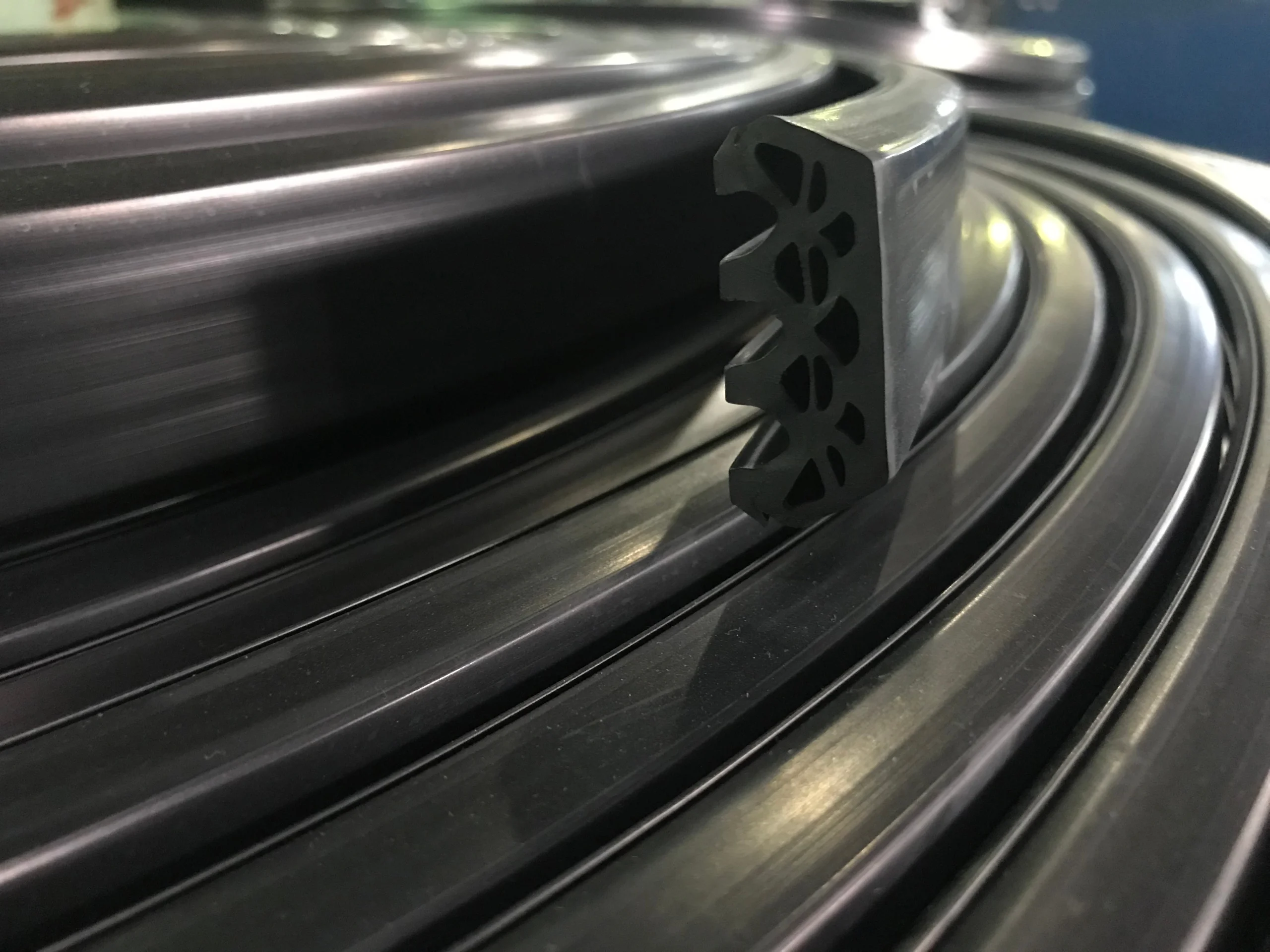
Reading the first article before the run
When the first cured profile comes off the die, the report should carry the cured cross section against the print, hardness on the profile itself, tensile and elongation to ASTM D412, the compound certificate against the D2000 callout, and the pull test on any splice, with compression set and ozone results from the compound lot attached. Read it for the three dimensions you marked, the hardness against the ±5, and the compression set against your limit, and ask for a photo of the cut section next to the print. That file is what answers a field claim in month six, and on our programs it reaches the buyer before the next foot of production runs, with the compound certificate filed in the PPAP package under its batch number so every seal traces back to its mix. On automotive programs that trace is usually the first thing a customer’s quality team asks for.
Three questions I get on EPDM profiles
What is the difference between EPDM and neoprene for a seal?
EPDM resists weather, ozone, steam and coolant and is the default for outdoor and automotive seals. Neoprene handles moderate oil and flame, where EPDM does not. If the seal sees fuel or oil, EPDM is the wrong family, and nitrile or a fluoroelastomer is the right one.
What tolerance can an EPDM extrusion hold?
Cross sections run to ISO 3302-1, usually class E2, which is ±0.40 mm on a 3 mm dimension and ±0.80 mm on a 12 mm one, widening as the dimension grows. Hardness holds to ±5 Shore A, and cut length runs to ISO 3302-1 class L2, ±2.0 mm on a 150 mm piece.
How long does a custom EPDM profile take from India?
The extrusion die takes 2 to 4 weeks, first article lands 4 to 6 weeks from the PO, and production runs land 5 to 8 weeks depending on compound, cure and splicing. A molded corner adds its mold build to that.
Send your drawing.Full landed cost in 5 business days.
DFM notes inside 48 hours. Part price, tooling, freight and duty shown as separate lines. First response inside 24 hours.
13+ years buying engineered parts experience. Last reviewed September 2026. LinkedIn