
$12.70 a piece, 250 pieces, die extra. That was the whole quote for an aluminum rail I approved in my buying years, 1 line in an email, and our engineering team had checked the section, so there was nothing wrong with the part. The trouble arrived 6 months later, when our finance manager asked me why the second lot had cost 30 percent more than the budget, and I could not answer him from that 1 line, because nobody had ever shown me what aluminum extrusion cost is made of. Now that I see these quotes from the manufacturing side with VIA INDIGOS, I know it is really 4 numbers at the plant and 2 more on the way to your dock, the die, the metal, the conversion charge, the finish and cut, then freight and duty, and a quote that rolls them into 1 figure cannot be checked or compared. So in this note I price 1 plain 6063 rail line by line from the billet to a US dock, and at the end I give you the arithmetic to do the same on your own section before the RFQ goes out.
Let's open up that 1 line quote
Send a cross section to an extruder and the quote usually comes back the way mine did, 1 line with the die extra, and you cannot tell from that line whether the metal was priced high, whether the press is charging a thin wall premium, or whether anodizing is inside the number. Every extrusion price is the same 4 parts underneath. The die is a 1 time charge. The metal is priced at the London Metal Exchange rate plus a billet premium on the day, where a billet is the solid log of aluminum the press starts from. The conversion is what the press charges per kg to push that billet through the die, and the finish, cut and pack come last.
Freight and duty come after the plant, and at the rates in force when this was written the duty line on aluminum is bigger than the conversion line, so it gets its own section further down. If you can get a quote broken into those 6 lines you can compare it with the next one and see which line is out of place, and if you cannot, you are comparing 2 numbers that were built differently. The die is the line buyers worry about first, so let me start there and take the worry away.
The die, and why it costs hundreds rather than tens of thousands
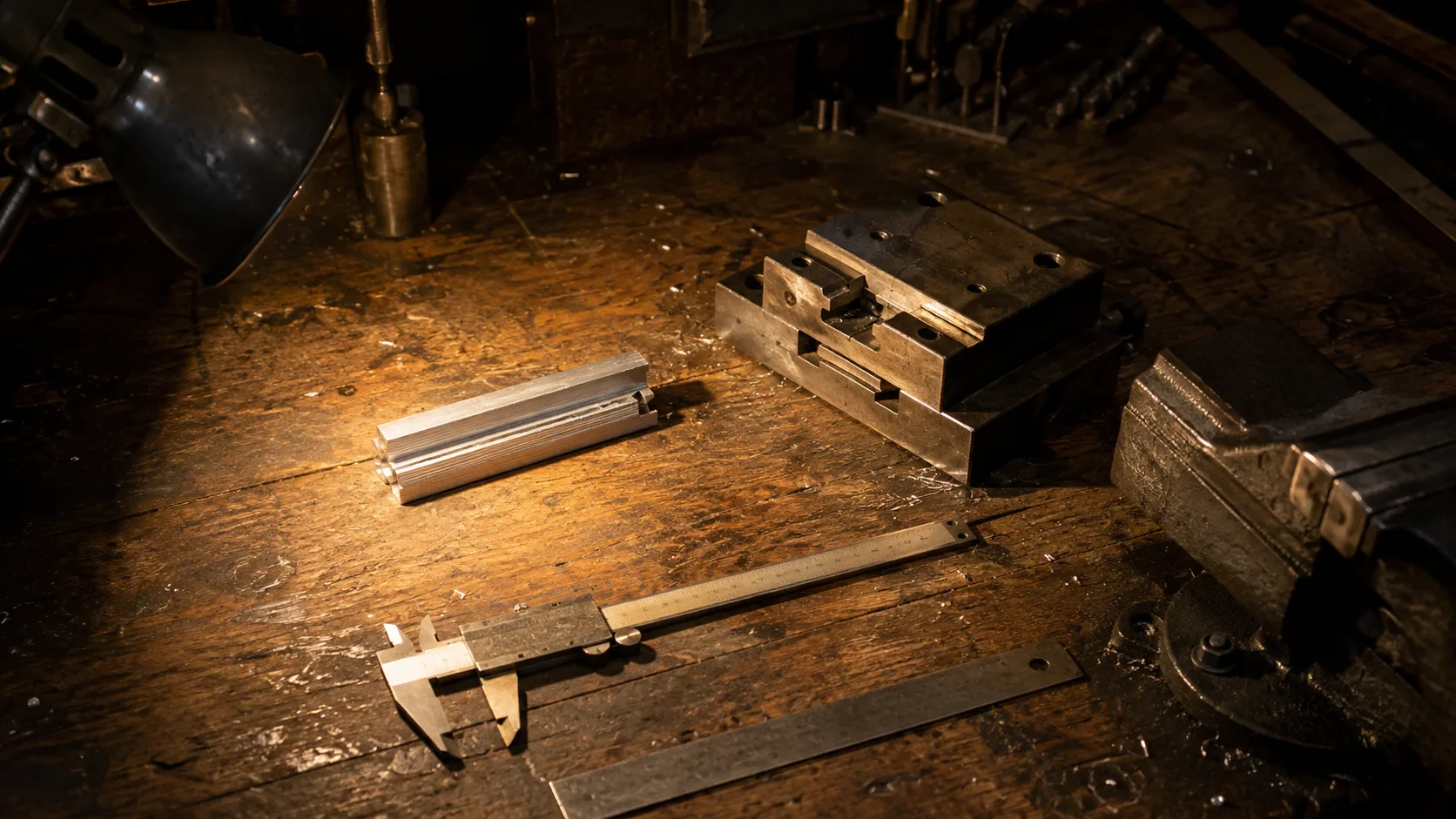
An extrusion die is a disc of H13 tool steel with the shape of your section wire cut through it, which is why the aluminum extrusion die cost sits at hundreds to a few thousand dollars where an injection mould or a progressive stamping die sits at tens of thousands. A solid section runs 2 to 4 weeks from PO to first trial, and a hollow section, which needs a 2 piece die with a mandrel to form the inside, runs 4 to 6 weeks and costs 2 to 4 times the solid.
The partner quotes I see put a solid die at $400 to $1,200 and a hollow die at $1,500 to $4,000 depending on the circumscribing circle, which is the smallest circle your whole section fits inside, and those are indicative figures that your section decides.
The buyer pays for the die and owns it on full payment, and the plant keeps it for the program under a tooling passport that records every trial, correction and run, so you always know where your die is and what state it is in. A die also wears, and a nitrided die on 6063 runs tens of tonnes before it needs a recut, which the passport records too. With the die out of the way, the next line is the one the plant does not control at all.
The metal, priced off the LME on the day you order
Aluminum is a traded metal, so the plant does not set its price, the London Metal Exchange does, and every extruder in the world buys billet at the LME price plus a regional premium. When this was written the LME 3 month price sat around $3,100 a tonne, which is $3.10 a kg, and the billet premium in India added roughly $0.20 to $0.30 a kg on top, so the metal in your part cost about $3.35 a kg before the press touched it. That number moves every day, which is why a serious quote carries the LME it was priced on and a formula for adjusting it, and why a fixed price for 12 months is either a gamble by the plant or padding in the price.
The alloy barely changes this line, because 6063 and 6061 billet carry almost the same premium, so if a quote on 6061 comes in much higher than 6063 the difference is in the conversion, not the metal. The metal line is the biggest line at the plant and the one nobody can negotiate, which makes the next line the only one where the plant and your designer actually have room to move.
The conversion charge, the only line the press controls
Conversion is what the plant adds per kg to turn billet into your section, and it covers press time, heat, the stretcher that pulls the profile straight, the aging oven that hardens it to T5 or T6, and the scrap cut off both ends of every billet. It depends on how hard the section is to push: weight per metre, wall thickness, how far the thinnest wall sits from the centre, and whether it is solid or hollow.
A solid 6063 section above 1 kg per metre with 2 mm walls converts for about $1.00 to $2.00 a kg in the partner quotes I see, and a thin wall or hollow section with walls at 1 to 1.5 mm converts for $2.00 to $3.50 a kg, because the press runs slower and scraps more.
This is the line where design pays back, because a wall that goes from 1.2 to 1.8 mm or a radius at a sharp corner drops the conversion and the scrap, and the DFM note that comes with our quote says which of those apply to your section. After the press, the profile still has to be finished and cut, and those lines are small on the sheet but they are where quotes most often hide things.
Anodize, cut and pack, priced per kg or per piece
Clear anodize at 10 microns, which is the thin protective oxide layer grown on the surface in an acid bath, runs about $0.60 to $0.90 a kg on a plain section, colour and 20 micron architectural anodize run higher, and powder coat is priced per square metre, so a section with a lot of surface for its weight costs more to coat than to extrude. Cut, deburr and pack add $0.10 to $0.20 a kg, and machining is priced per piece on top.
Whether a part should be anodized or powder coated is a separate question, but on the price sheet both sit on their own line, and a quote that folds them into the per kg price is a quote you cannot check. Those are the 4 plant lines, and before I add them up there is a question about quantity that decides whether you get a good price per kg at all.
Why the press wants a few hundred kilos per section
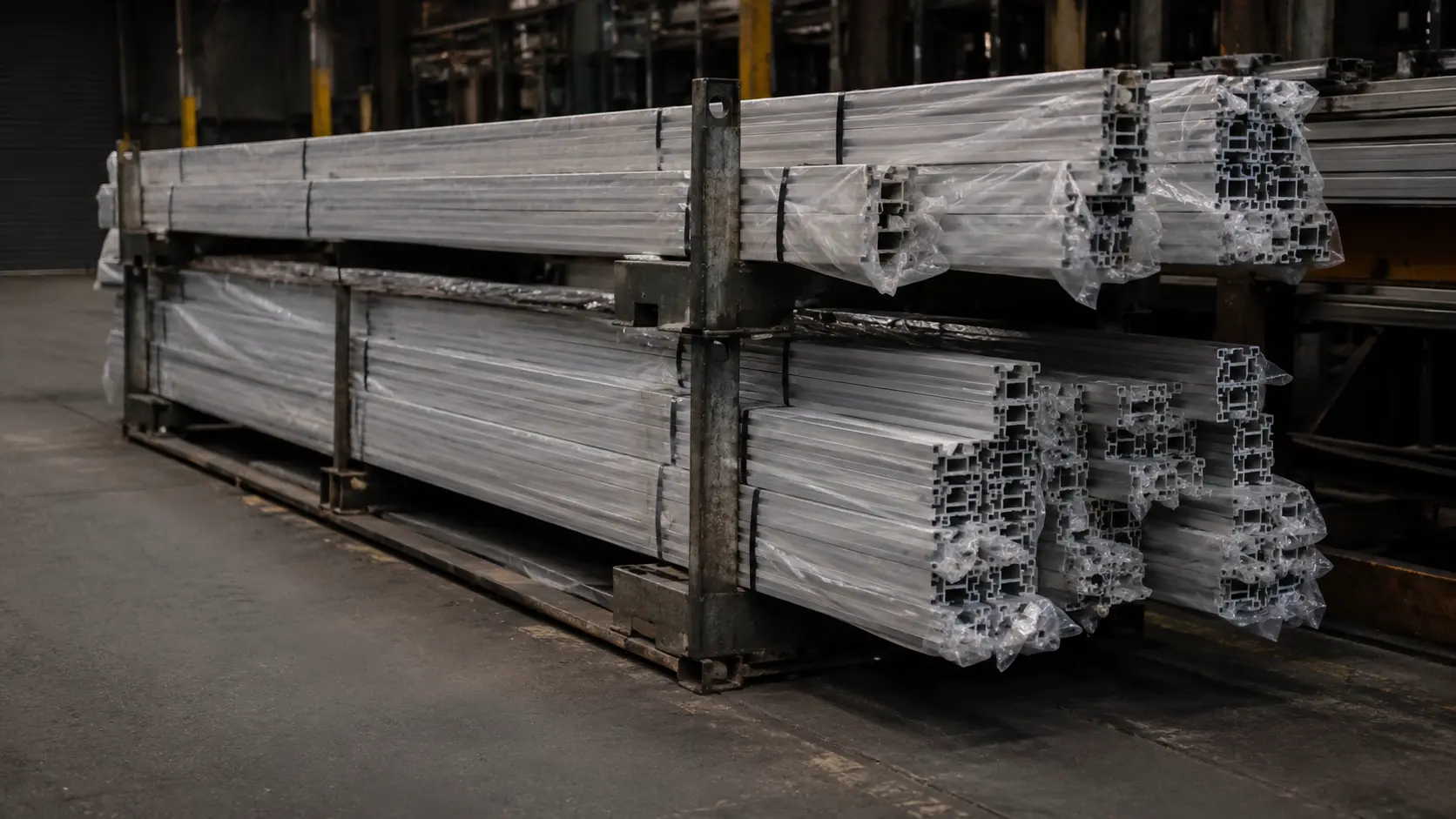
A press has to be set up for your die, the first billets are scrapped while the section comes to size, and the runout table, stretcher and oven are tied up for the run, so a custom die program is quoted at 250 to 500 kg per section per release at VIA INDIGOS manufacturing partners, and below that the price per kg climbs fast. If your annual need is under that, a catalog die the plant already owns runs from about 100 kg per release with no die cost, and sometimes the honest answer is a catalog section with a machining operation rather than a custom one.
For the rail below, a release of 250 pieces at 2 m is 567 kg, which clears the minimum with room, and that is the number I want you to carry into the next section, because every line in it is priced on that release and not on a year. Let me now put the whole thing on 1 sheet.
Let's price 1 rail from billet to your dock
The part is a solid 6063 T5 rail, cross section 420 mm², which at 2.7 g per cm³ weighs 1.134 kg per metre, cut to 2,000 mm, so 2.268 kg a piece, clear anodized, 250 pieces per release, shipped LCL by sea, which means a shared container, to a US East Coast dock. Every figure is indicative, at the prices and rates in force when this was written, and duty is charged on the transaction value, which is the ex works price of the release, never on the freight.
- Plant price per kg is metal $3.35 plus conversion $1.40 plus anodize $0.70 plus cut and pack $0.15, which is $5.60, and times 2.268 kg is $12.70 a piece.
- The release is 250 pieces times $12.70, which is $3,175, and that is the value duty is charged on.
- Duty is MFN 5 percent plus Section 232 aluminum at 50 percent, so 55 percent of $3,175 is $1,746, which is $6.99 a piece.
- Add the $900 die spread over 250 pieces, $3.60, and freight and clearance at $3.20, and the first release lands at $26.49 a piece.
| Line | Per kgex works India | Per piece2.268 kg, 250 pieces | How it is figured |
|---|---|---|---|
| Metal, LME plus premium | $3.35 | $7.60 | LME $3.10 when this was written + $0.25 billet premium |
| Conversion | $1.40 | $3.18 | Solid section, 1.1 kg per m, 2 mm walls |
| Clear anodize, 10 micron | $0.70 | $1.59 | Plain section, racked |
| Cut, deburr, pack | $0.15 | $0.34 | +0 minus 1.5 mm, bundled |
| Ex works, the plant price | $5.60 | $12.70 | Release value $3,175 |
| Die, first release only | $1.59 | $3.60 | $900 solid die ÷ 250 pieces |
| Freight and clearance | $1.41 | $3.20 | LCL, about 0.6 m³, origin, ocean, broker |
| Duty, when this was written | $3.08 | $6.99 | MFN 5% + Section 232 aluminum 50% on $3,175 |
| Landed, first release | $11.68 | $26.49 | All lines |
| Landed, repeat release | $10.09 | $22.89 | Die paid off |
of the plant price is added again as duty on this rail, so the duty box below is nearly as big as the metal box. Compare landed cost on aluminum, never the plant price, and ask every quote to show the duty as its own line.
Look at the plate and you can see the shape of my old rail. The plant lines were fine, and what nobody had put in front of me was the die on the first release and the duty, which together were more than the part. The duty box deserves its own explanation, because it is the one that changes.
The duty line, and why it is the biggest line
At the rates in force when this was written, an extruded aluminum profile from India under HTS 7604.29 pays its normal rate, 5 percent on a solid alloy profile and 1.5 percent on a hollow one, plus the Section 232 tariff on aluminum articles, 50 percent on the full customs value under the proclamation that raised the aluminum rate, and the 10 percent base tariff on India does not apply on top of a 232 article. There is no antidumping or countervailing duty on extrusions from India, because the US International Trade Commission voted that imports from India and 13 other countries were not injuring the US industry, and the case closed with no orders.
The same profile from China pays the same 232 line plus Section 301 at 25 percent plus the antidumping orders that do sit on Chinese extrusions, which is why the landed gap on aluminum is wider than on most part families. Check the 10 digit code and the rates with your broker on the USITC schedule the day you quote, because this is the line that moves. Now let me go back to my rail, because the lesson in it was not about duty at all.
What went wrong on my rail
When I finally sat down with the plant and the invoices, the answer to my finance manager’s question was that I had priced the year and ordered the quarter. The $12.70 was quoted on 2,000 kg a year, and the first lot was 400 kg, so the press had set up 4 times instead of once, the scrap at the start of every run was the same whether the run was long or short, and the second quote came back higher on a number the plant had never promised for that release size.
The die made it worse, because in my budget it was spread across a year of parts, while the invoice for it arrived with the first release, and the engineering review could not have caught any of this, because it was a buying question, not a drawing question.
The fix turned out to be 1 line on the RFQ, the release size and the number of releases a year, and every extruder on the press floor prices faster and lower when that line is there. Write the release size, not the annual volume, and the quote you get back is the one you will pay. That leaves the promise I made at the start, the arithmetic you can run yourself.
A cost estimator you can run before the RFQ
You do not need a quote to get within 15 percent of the answer, you need the cross section area and 5 rates, and this aluminum extrusion cost estimator fits on the back of the drawing. First, weight per metre: area in mm² × 2.7 ÷ 1,000, so 420 mm² gives 1.134 kg. Second, the release: 1.134 × 2 m × 250 pieces gives 567 kg. Third, the plant price per kg: the LME on the day plus $0.25, plus $1.00 to $2.00 conversion for a solid or $2.00 to $3.50 for a thin wall or hollow, plus $0.60 to $0.90 for clear anodize, plus $0.15 to cut and pack, which for this rail is $5.60.
Fourth, duty: plant price × 0.55 at the rates in force when this was written. Fifth, freight: $700 to $1,000 per small LCL release to the East Coast, or about $0.15 to $0.25 a kg on a full 40 ft container. Add the die once, divide by the pieces, and you have the custom aluminum extrusion cost per piece before the RFQ goes out, so when the quote comes back you can see which line is out of place. Run those 5 steps on your section tonight, and send the drawing with the release size written on it.
What buyers ask about aluminum extrusion pricing
How much does an aluminum extrusion die cost?
Hundreds to a few thousand dollars. Partner quotes put a solid section die at about $400 to $1,200 and a hollow die at $1,500 to $4,000, depending on the circumscribing circle, with 2 to 4 weeks to first trial on a solid die and 4 to 6 on a hollow one.
What is the price per kg of extruded aluminum?
Metal at the LME plus a billet premium, about $3.35 a kg when this was written, plus conversion of $1.00 to $3.50 a kg depending on the section, plus finish and cut. A plain anodized 6063 section runs around $5 to $7 a kg ex works, about $2.30 to $3.20 a pound, before freight and duty.
What is the minimum order for a custom aluminum extrusion?
Custom die programs run 250 to 500 kg per section per release at VIA INDIGOS manufacturing partners. Below that a standard catalog section from about 100 kg per release usually makes more sense, with no die cost.
Does aluminum extrusion from India pay the Section 232 tariff?
Yes, at the rates in force when this was written aluminum articles under HTS 7604 pay the normal rate of 1.5 to 5 percent plus Section 232 at 50 percent of the customs value, from every country without a special deal. There is no antidumping duty on Indian extrusions after the USITC vote that closed the case with no orders. Confirm the rate with your broker on the day.