
Almost every week a housing drawing comes to VIA INDIGOS with the aluminum for die casting written as A380, and almost every week our manufacturing partner in India asks the same thing, whether ADC12 would be acceptable instead. The buyer then calls me, and he usually asks it carefully, because he wants to keep the program moving and he also wants to be sure he is not approving a weaker metal. I respect that question, because as a supply chain head I signed off on material changes like this one, with our engineering team’s review behind me, and I always wanted to understand the change better than the approval form asked me to. Now that I work with the plants that pour these alloys every day, I can give him the answer in plain words in about 10 minutes, and I want to give you the same 10 minutes here. We will go through A380, ADC12 and A356 the way the plant reads them, and by the end you will know when yes is the right answer, when it is not, and roughly what 3 different housings cost in each.
First, which alloy is actually being melted, and how you know
Open the material block on your housing drawing. The first line needs an alloy name and the standard that defines it, because A380 on its own is a conversation and A380.0 to ASTM B85 is a contract. A380 is the general purpose die casting alloy of the US, roughly 8.5 percent silicon and 3.5 percent copper in aluminum. ADC12 is its Japanese cousin to JIS H5302, with more silicon, about 9.6 to 12 percent, and a wider copper range, 1.5 to 3.5 percent, and it is the alloy most Indian and Chinese die casters melt by default, because the ingot is everywhere and cheap.
A383 in the ASTM system is the closest American name for ADC12, which is why the plant’s question to my buyer was a fair one and not a shortcut. A356 is a different animal, a low iron alloy with a little magnesium in it, written to ASTM B108 for permanent mould and B26 for sand, with about 7 percent silicon and almost no copper, and it is chosen when the part has to stretch before it breaks or has to be heat treated. Write the designation, the suffix and the standard, and ask for the spectrometer certificate for every heat, which is the printout showing what was actually in the metal when it was poured, because the chemistry is the one thing about a casting you can check after the fact without cutting it up.
That covers what is in the metal. The next question, and the one that separates A356 from the other two completely, is how the metal gets into the shape of your part.
Why A356 is made on a different machine altogether
A380 and ADC12 are high pressure die casting alloys. The molten metal is shot into a hardened steel die at high speed, the cycle takes 30 to 90 seconds, the walls can be as thin as 1.5 mm, and the drawing needs draft angles and a parting line. The die itself costs $15,000 to $80,000 from our manufacturing partners and takes 8 to 14 weeks. The copper in these alloys gives them strength and makes them easy to machine, the silicon makes them flow into thin walls, and the iron in them, up to 1.3 percent, is there on purpose, because it stops the aluminum sticking to the steel die.
A356 is poured into a mould rather than shot into a die. It goes into a gravity or low pressure mould, or into sand, slowly and with far less turbulence, which is why it can be low in iron and far more ductile, and why it can be heat treated without blistering. So if your drawing says A356 and the plant quotes die casting of aluminium under high pressure, one of the two has to change, and in my experience it is usually the drawing, which was copied from a wheel or a suspension part years ago without anyone asking why. The way the metal gets into the mould also decides the next line on the drawing, which is the temper.
Why your die casting is never heat treated, and A356 always is
For A380 and ADC12 the temper is F, which means as cast, almost without exception. A high pressure die casting traps a little gas in the metal as it fills, and if you heat it to 500 °C and more to strengthen it, that gas expands and the skin blisters, so conventional die castings are used as they come out of the die, and their strength comes from the fast cooling in the steel and the copper in the alloy. Vacuum assisted die casting changes that and lets some structural castings take a T6 or T7 treatment, but that is a special process at a premium and most housings do not need it.
A356 is the opposite case, because as cast it is soft, about 160 MPa tensile, and nobody buys it that way. You write T6, which means solution treated and aged, and the typical numbers jump to about 262 MPa tensile, 186 MPa yield and 5 percent elongation, which is why wheels, steering knuckles and pressure tight pump bodies are A356 T6. The temper line costs a heat treatment cycle, a day or two of lead time and a few percent on the price, and on that alloy it is not optional. Now for the numbers themselves, and this is the part where buyers get caught out, including me for a few years.
The strength numbers you can hold a plant to, and the ones you cannot
ASTM B85 and JIS H5302 specify the chemistry of a die casting alloy and say nothing binding about tensile strength, because the strength of a die casting depends on the wall, the feed and the shot, not only on the alloy. The numbers you see quoted, A380 at about 324 MPa tensile, 159 MPa yield and 3.5 percent elongation, ADC12 at about 310 MPa, 150 MPa and 2 to 3.5 percent, are typical values from separately cast test bars, and the plant will tell you so if you ask. I signed off on drawings for years that quoted those figures as if they were a promise, and nobody at the plant ever corrected me, because nobody had asked.
If a property matters, write it as a requirement on a test bar cast with the lot, or on a coupon cut from a named location on the part, and agree the method before the first shot. For A356 T6 the standard does carry minimums and a sound casting will make them, 234 MPa tensile and 165 MPa yield with 3.5 percent elongation on a separately cast bar to B108, so there you can write the minimum and hold it. Hardness is the same story, typical not minimum, about 80 HB for A380 and ADC12 and 70 to 80 HB for A356 T6. Here are all 3 side by side, the way I keep them pinned above my desk.
Porosity, the line on the drawing that usually gets left blank
This line decides whether your housing holds oil. A die casting always has some porosity, small voids where gas or shrinkage was trapped, and the question is how much, where, and whether the voids connect. Write the acceptance level to ASTM E505, the reference X ray images for aluminum die castings, by grade and by zone, so that a pore in a thick boss that will be drilled out is treated differently from a pore in a sealing face. If the part holds pressure, write the leak test, the medium, the pressure and the time, and say whether vacuum impregnation, which fills the pores with resin, is allowed, because every die caster in the world will impregnate a leaking part if the drawing does not forbid it.
If a machined face has to be free of pores, say so, and expect the plant to move the feed point or add a squeeze pin to give it to you. On our programs these 5 lines, the alloy, the process, the temper, the properties and the porosity, are settled on the DFM call before the die is cut, and the first article report carries the X ray grade and the leak result next to the dimensions, because a housing that measures right and weeps oil is still a bad housing. With the drawing complete, let’s put real money on 3 real parts.
Let's price 3 housings in 3 alloys
Start with my buyer’s part, a motor end shield, 1.2 kg, 20,000 a year, walls at 3 mm with a bearing bore machined after casting. It is an ADC12 or A380 part, and at a VIA INDIGOS manufacturing partner in India it will be ADC12 unless the drawing says otherwise, at about $4 to $5 a piece as cast. The answer to the plant’s question was yes, run it in ADC12, write A383 or ADC12 on the drawing so the certificate matches, and move on, and the buyer had his answer the same afternoon.
A sensor bracket, 180 g, 60,000 a year, thin and intricate, wants the flow of ADC12 and does not care about ductility, at about $0.90 to $1.20 a piece. A hydraulic pump body, 3.5 kg, 4,000 a year, that holds 200 bar and has a mounting flange torqued hard, is an A356 T6 part from a gravity die at our partner foundries, at perhaps 3 times the per kilo price of the die casting and a mould at a quarter of the cost, and anyone who quotes it as an A380 die casting to save money is quoting you a leak. What happens to these prices after they leave the plant is in the India vs China note.
| Three housings, indicative | Motor end shield | Sensor bracket | Hydraulic pump body |
|---|---|---|---|
| Weight and volume | 1.2 kg, 20,000 a year | 180 g, 60,000 a year | 3.5 kg, 4,000 a year |
| What it has to do | hold a bearing bore, 3 mm walls | fill thin, intricate walls | hold 200 bar, take flange torque |
| Alloy and process | ADC12 or A380, high pressure die cast | ADC12, high pressure die cast | A356 T6, gravity die |
| Tooling | about $25,000 to $35,000 | about $15,000 to $22,000 | about $8,000 to $12,000 |
| Piece price as cast, ex works India | about $4 to $5 | about $0.90 to $1.20 | about $22 to $28 |
What our manufacturing partners pour every day
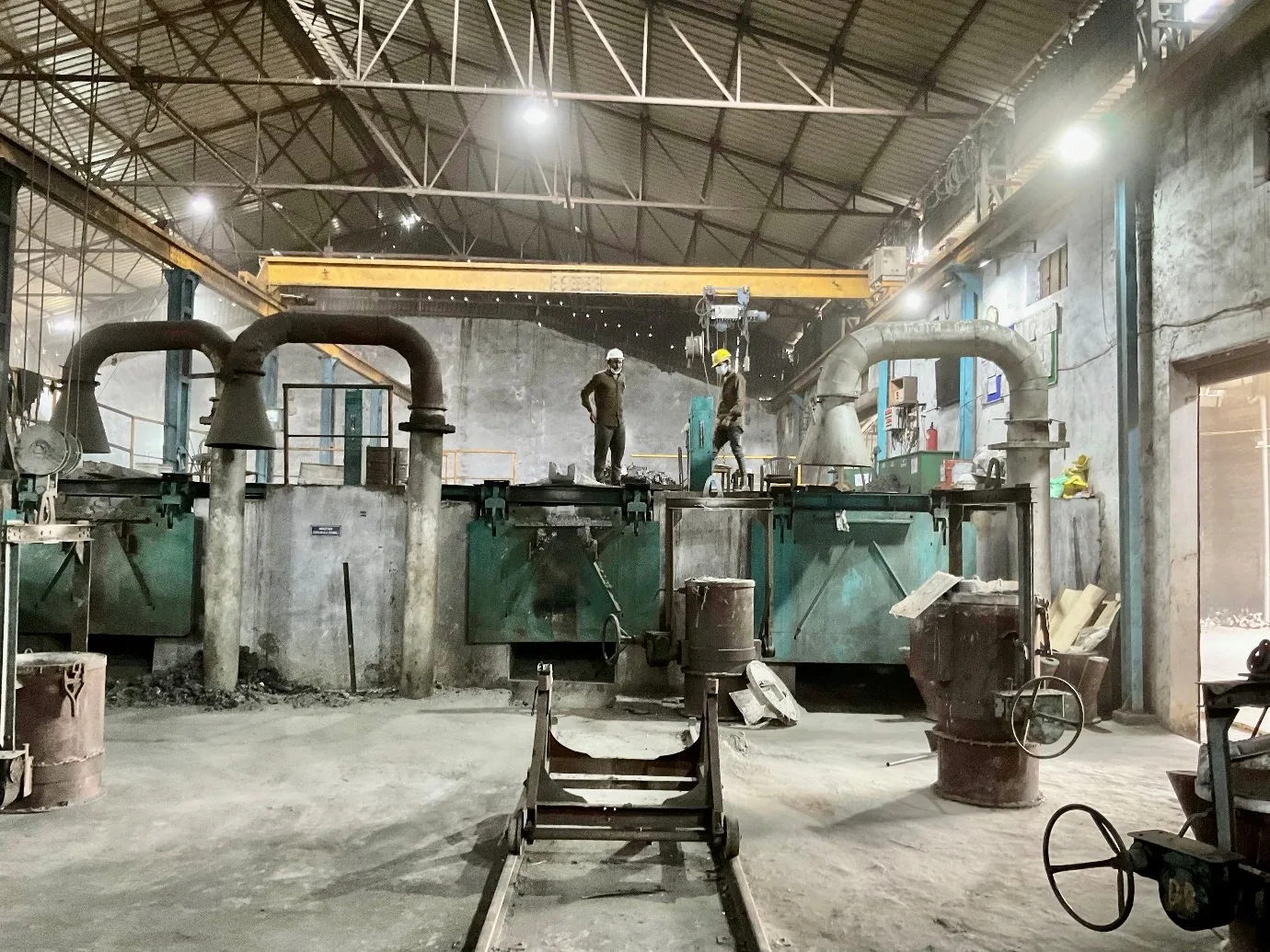
Our partner die casters in India run ADC12 as the house alloy on machines from 250 to 1,600 tonnes, hold A380 ingot for drawings that insist on it, and run A356 in gravity and low pressure cells with their own heat treatment, so all 3 alloys in this note come from plants we are in every day. Every heat is sampled on the spectrometer before the shot, the certificate travels with the lot, and the X ray and leak results sit on the first article report next to the dimensions, which is what a US buyer expects and what most plants only do when someone is standing there asking.
Our engineers are in those plants every day, not on visits, so the die trial, the first shots and every production lot has one of our people at the machine with the drawing in hand, and the weekly tollgate email you get every Friday lists every open item, the date it was promised and the date it will land. For 13 years I was the one reading die casting certificates after the parts had already landed, and a plant that asks a good question about the alloy before the die is cut is a plant I want on my side, and on yours. If your drawing says aluminum and not much else, send it over and we will fill in the 5 lines with you before anyone quotes it.
Questions buyers ask us about aluminum die casting alloys
Which aluminum is best for die casting?
For most housings, brackets and covers, A380 or ADC12, which are the general purpose high pressure die casting alloys of the US and Asia. They fill thin walls, machine well and cost the least. A356 T6 is the choice when the part must be ductile, heat treated or pressure tight, but it is a gravity or low pressure casting alloy, not a high pressure die casting alloy.
What is the difference between A380 and ADC12?
ADC12 has more silicon, 9.6 to 12 percent against 7.5 to 9.5, and a wider copper range, 1.5 to 3.5 percent against 3 to 4. In practice they behave alike in a die, and A383 is the ASTM name closest to ADC12. Indian and Chinese plants melt ADC12 by default because the ingot is cheaper and everywhere, so write ADC12 or A383 on the drawing if you are happy with it, so the certificate matches.
Can a die casting of aluminium be heat treated?
Conventional high pressure die castings in A380 or ADC12 are used as cast, temper F, because trapped gas blisters the skin above about 500 °C. Vacuum assisted die casting allows a T6 or T7 at a premium. A356 cast by gravity or low pressure is always heat treated to T6, which takes it from about 160 MPa to a minimum of 234 MPa tensile.
What tensile strength can I specify on an A380 casting?
ASTM B85 specifies chemistry, not tensile strength, and the 324 MPa you see quoted is a typical value from a separately cast bar. If a property matters, write it as a requirement on a test bar cast with the lot or on a coupon from a named location on the part, and agree the test method before the die is cut.