
The standard brake rotor material is G3000 grey iron, with a minimum tensile strength of 207 MPa, a hardness of 187 to 241 HB, and a carbon content that typically runs from 3.30 to 3.55%. A high carbon rotor uses a grey iron with at least 3.40% carbon, and some grades ask for 3.50% or more.
That extra carbon forms more graphite in the iron. Graphite carries heat away from the braking face and absorbs vibration, so a high carbon rotor runs quieter and stands up better to repeated hard stops. Which one your program needs depends on the vehicle and on what your customers complain about.
Brake rotor material comparison: the grades side by side
These are the grades you will meet on rotor drawings and quotes. G3000 and its high carbon relatives come from SAE J431, the US standard for automotive grey iron castings. GG25 is the older German name for EN-GJL-250, which is the European grade most rotor drawings from Europe call for.
| Grade | Standard | Minimum tensile | Hardness | Carbon |
|---|---|---|---|---|
| G3000 | SAE J431, close to G11H18 in the current edition | 207 MPa (30 ksi) | 187 to 241 HB | 3.30 to 3.55% typical |
| GG25, EN-GJL-250 | EN 1561 | 250 MPa | To the drawing | Set by the foundry to meet the strength |
| G2500a, high carbon | SAE J431 | 172 MPa (25 ksi) | 170 to 229 HB | 3.40% minimum |
| G3500b, high carbon | SAE J431 | 241 MPa (35 ksi) | 207 to 255 HB | 3.40% minimum |
| G3500c, high carbon | SAE J431 | 241 MPa (35 ksi) | 207 to 255 HB | 3.50% minimum |
Two things stand out in that table. The phrase “high carbon” covers more than one grade, so it is not a specification until a grade is named. And the difference in carbon between a standard and a high carbon iron is a few tenths of 1%, which sounds small and changes how the rotor behaves. To see why, it helps to know why rotors are grey iron at all.
Why almost every road rotor is grey iron
A rotor has one job, which is to turn the motion of the vehicle into heat and then get rid of that heat. Grey iron is very good at this. The carbon in it sits as flakes of graphite spread through the metal, and graphite conducts heat well. The flakes also break up vibration, which is why grey iron damps noise far better than steel does.
Grey iron is also cheap to cast, easy to machine to a fine finish, and stable when it is heated and cooled thousands of times. Carbon ceramic rotors exist and are lighter, but their cost keeps them on a small number of high performance cars. For passenger cars, trucks and trailers, the question is which grey iron to use.
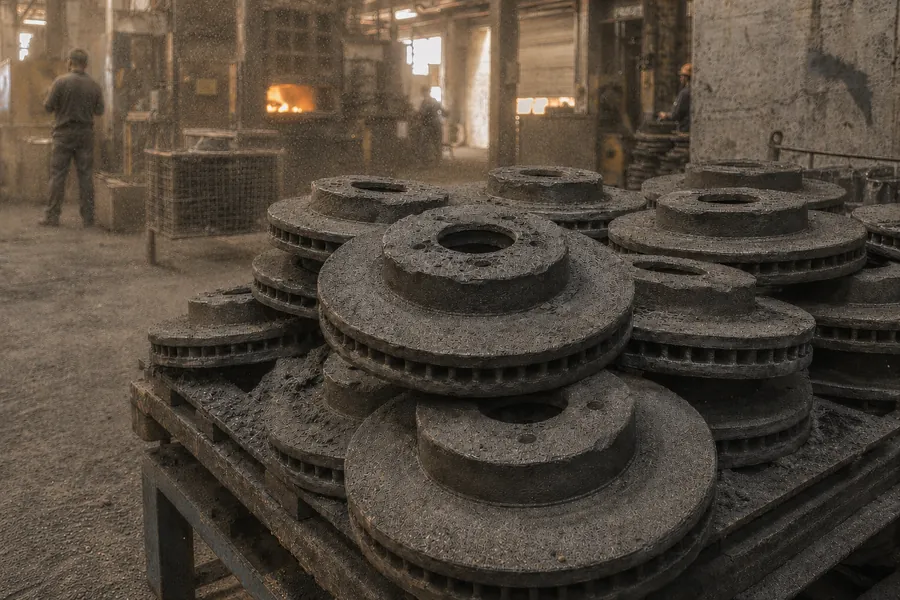
What high carbon changes, and what it asks of the foundry
Raising the carbon gives the iron more graphite. More graphite means heat moves out of the braking face faster, so the surface runs cooler and is less likely to crack from repeated heating. It also means more damping, which shows up as less squeal and less judder at the pedal.
The same graphite flakes that help with heat and noise are weak points in the metal, so more of them tends to lower the strength. That is the trade the foundry has to manage. It does it through the rest of the chemistry and through how fast the casting cools, and the G3500b and G3500c grades show that a high carbon iron can still reach 241 MPa.
This is why a high carbon rotor often costs a little more, and why it depends more on the foundry. A tighter chemistry window needs closer control of every melt, and the grade should be proven by a test bar and a hardness check from each batch. So the useful question is when that extra control pays you back.
Which is the best brake rotor material for your program?
There is no single best brake rotor material, because the right grade depends on how the vehicle is used. These 2 lists are how I would sort a program.
Stay with G3000 or GG25 when
- The rotor is for everyday passenger cars and light trucks.
- Your drawing or your customer already names that grade.
- Price per rotor decides the program.
- You have no history of noise or cracking complaints.
Move to high carbon when
- The vehicle is heavy, tows, or brakes hard and often.
- You are getting returns for squeal, judder or heat cracks.
- You sell a premium line and want a real difference behind it.
- The original part was high carbon and you are matching it.
Our manufacturing partners cast brake rotors in G3000, GG25 and high carbon grey iron, so the grade can follow the program. If you are replacing an existing rotor, send a sample or its material report, because matching the original grade is the safest starting point.
What to write on the drawing, and what to ask for with each lot
A rotor drawing that says “grey iron” or “high carbon” leaves the real decision to whoever quotes lowest, and these lines close that gap.
- Name the grade and its standard, such as G3000 to SAE J431 or EN-GJL-250 to EN 1561.
- For high carbon, name the grade or state the carbon range you want.
- State the hardness range and where on the rotor it is measured.
- Ask for the tensile result from a test bar poured with each batch.
- Ask for the chemistry of each melt, with the batch number that is also marked on the castings.
That last line matters more than it looks. A material certificate can be genuine and still fail to prove that the iron in your rotors came from the batch it describes, which we explained in this post on our company page. The batch number has to travel with the castings through machining and packing for the certificate to mean anything.
If you want to compare 2 grades on your own rotor, send the drawing and the vehicle it fits, and ask for both to be priced.
Questions buyers ask about brake rotor materials
What material are brake rotors made of?
Almost all road vehicle rotors are grey cast iron, most often G3000 to SAE J431 or EN-GJL-250, also called GG25. Grey iron conducts heat well, damps vibration and machines to a fine finish. Carbon ceramic is used on a small number of high performance cars.
What is a high carbon brake rotor?
A rotor cast in grey iron with a higher carbon content, at least 3.40% in the SAE J431 high carbon grades and 3.50% in one of them. The extra carbon forms more graphite, which carries heat away faster and damps noise and judder.
Are high carbon rotors better than standard rotors?
They are better at handling heat and noise, so they suit heavy vehicles, towing, hard braking and premium lines. For everyday passenger cars a standard G3000 or GG25 rotor does the job at a lower cost.
What is G3000 in brake rotors?
G3000 is a grey iron grade from SAE J431 with a minimum tensile strength of 207 MPa, or 30,000 psi, and a hardness of 187 to 241 HB. The current form of the standard writes a similar grade as G11H18.